House Sparrows suffer from a poor self-image
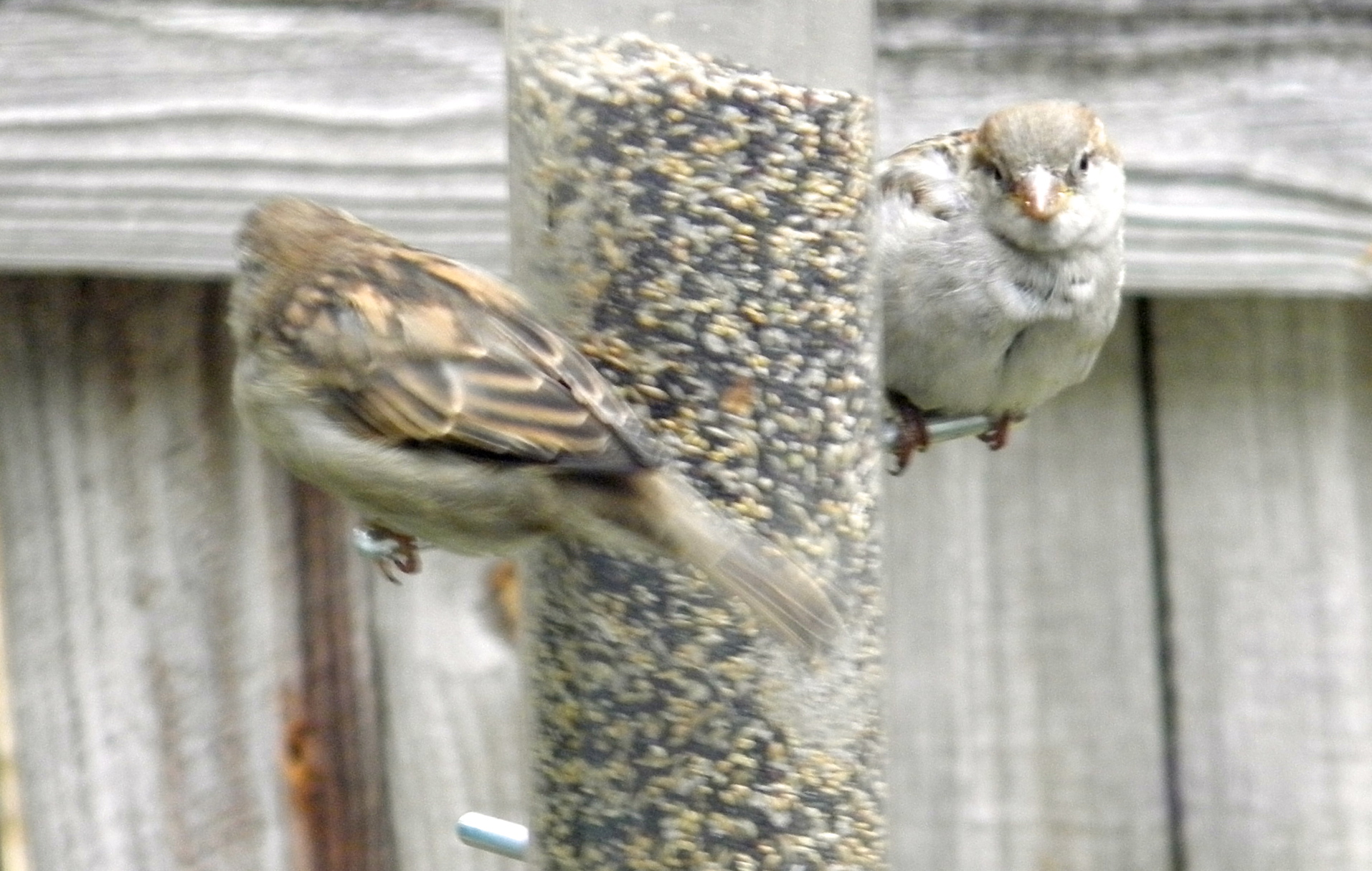
Two female House Sparrows are happy to share the feeder, as long as they can’t quite see each other.
This time of year – late summer, early fall – House Sparrows are like gangs of bratty school kids. Males and females hang out in noisy, pushy, messy little crowds, jostling each other and anything smaller than they are for what they seem to think is the prime perch on the bird feeder. It doesn’t matter that one perch offers no more food than another. It’s apparently just the principle of the thing.
Like the human miscreants they resemble, House Sparrows probably suffer from low self-esteem. After all, they aren’t actually sparrows; they’re finches. But they can’t be called House Finches because that name has already been snatched by a much more attractive bird.
Originally a left-coast sort of fowl, House Finches moved from west to east to conquer much of the continent by the latter decades of the twentieth century. They often sport a crimson, reddish-orange or even yellow head and breast, giving them a certain flare that even the male House Sparrow, with its black ascot-like breast marking, just can’t match. As for the female: it’s dull grayish-brown up top and dull grayish-white down under. The female House Finch at least has stripes to liven up it’s buff-colored breast and belly.
Then there’s the music. House Finches offer a bright, melodious song. House Sparrows peep and screech. Think Michael Bublé vs. Bob Dylan, without Dylan’s poetic sensibilities.
To make matters worse, House Sparrows, unlike House Finches, aren’t even natives. They arrived in Brooklyn, New York, from England in 1851. (Talk about starting out on the mean streets.) Once on shore, they spread until they began showing up just about everywhere people live in North and South America. Other birds, whose nests House Sparrows sometimes displace, could be forgiven for being less than pleased at the usurpers’ arrival.
(Disclaimer: Any reference to the current immigration debate in the U.S. Congress concerning human beings is entirely in the mind of the reader and should be discarded as quickly as every attempt so far to resolve the human immigration debate in the U.S. Congress.)
Whatever their origin and behavior, it seems clear House Sparrows are here to stay and prosper. They’re a lot like people that way.
 Bird Poop