We find unusual and inebriated birds
If you don’t subscribe to the Cornell Lab of Ornithology’s eBird Rare Bird Alerts, you’re missing a great digital birding resource. It’s free, and you can get the service for every state and even other countries. It gives you all the information you need to locate rare birds in the area, with daily updates.
I bring eBird up because it came in handy lately. My brother Phil used it to pick up a Thayer’s Gull and Lesser Black-backed Gull on the lake at a nearby Kansas park. The sightings were some compensation for several trips to the same park in search of a Townsend’s Solitaire. That bird didn’t cooperate.
Although they’re becoming more widespread, the Thayer’s Gull and Lesser Black-backed Gull are still unusual in our part of the world and, as Phil put it, still as difficult as any other winter gull to identify with certainty. It’s good to have more than one reference to look at when ID’s are iffy. Phil used three or four.
Don’t like to drag printed field guides along on your birding walks? Another excellent resource is an app called iBird. I have iBird Ultimate on my phone and used it the other day to identify a Ruby-crowned Kinglet while I was walking our dog Lucy.
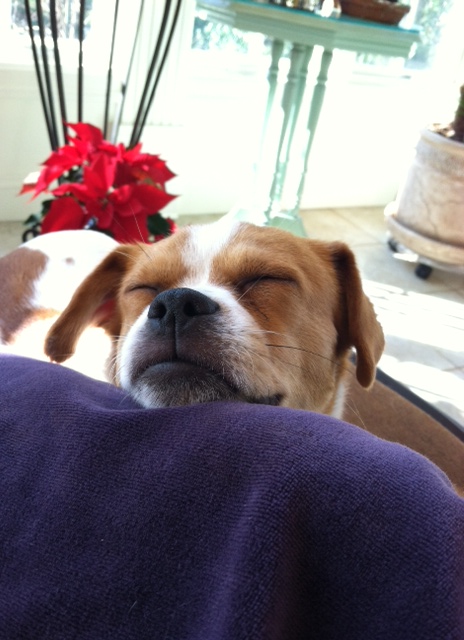
Yes, this blog is supposed to be about birds and birding. But, come on. Is Lucy not an adorable animal?
The app gives you not only illustrations and photos but also species’ ecology, identification points, range and other data. For example, did you know that a group of Ruby-crowned Kinglets is called a castle, court, princedom or dynasty?
Now, about the avian drunks I referred to in the headline. This time of year, trees sometimes still have fruit dangling from their limbs. If it has hung around long enough to ferment, birds seem to find it particularly attractive and belly up to the bar for a bender.
Robins are famous for this misbehavior, but I think Cedar Waxwings indulge, too. It certainly looked that way the day Lucy and I spotted the Ruby-crowned Kinglet.
A flock of about 10 waxwings occupied a medium-sized crabapple tree still dense with fruit. The small “apples” were soft and seemed rotten, but they were more likely soft and sodden, as were the waxwings. I can now say with authority that birds can fly with a stagger. Still, even waxwing sots count as a new species for 2015.
Official Big Year species count as of 23 January: 69.
 Bird Poop