Interchangeable accipiters should move out of each other’s territories
Here’s the thing. Accipiters – Cooper’s hawks, sharp-shinned hawks and northern goshawks – annoy me. The young ones look pretty much alike, except for size, which isn’t a great identifier unless they’re sitting next to each other. Cooper’s hawks and sharp-shinned hawks look even more the same as adults.
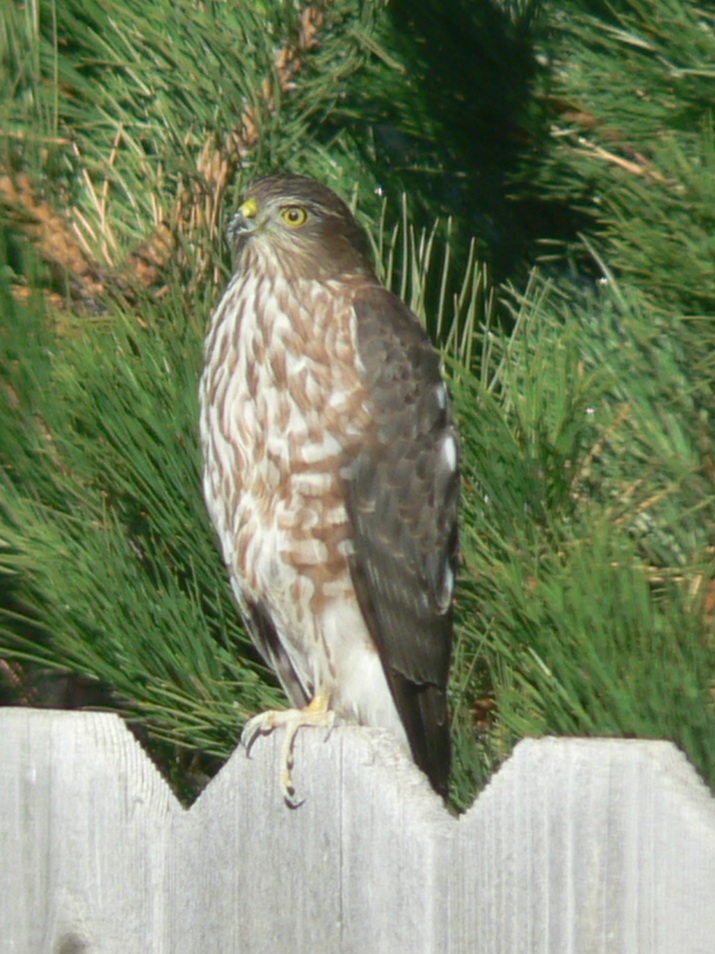
How we mistook this Northern Goshawk for a Cooper’s Hawk is an embarrassing mystery. It’s a Northern Goshawk, right? Tell me it is. Please. Photo by Terence Ryan.
These similarities wouldn’t be an issue if the birds would just take up residence in different parts of the country. Goshawks could live, say, in 21 of the states west of the Mississippi, Cooper’s hawks in the 28 states east of the Mississippi and sharp-shinned hawks in Kansas.
Sharp-shinned hawks are the smallest of the three species, so they’d leave more room for the flood of new businesses moving into the state since Gov. Sam Brownback’s tax cuts took effect.
I bring all this up because, as I was trying to find a subject for this blog I found a photo my brother Terry snapped of a brown hawk with a streaked breast. When I first saw it sometime last year, I thought, “Cooper’s Hawk,” and put it in a file.
I found it this morning and decided to make sure it was a Cooper’s Hawk rather than a Sharp-shinned Hawk. Wrong on both counts.
My trusty Sibley Field Guide to Birds of Eastern North America cleared things up. The bird I was looking at in the photo had a distinctive yellow mark over the beak and a white “eyebrow.”
Juvenile Northern Goshawk. And it never made it onto our 2014 Big Year list.
Stupid, stupid, stupid accipiters. Blind, blind, blind birders. Bummer.
Of course, I added Northern Goshawk to the 2014 list anyway. I might be a blind idiot but I’m not a blind fool. You don’t see these critters every day, so they really dress up a list. We see it. We count it. Even if it takes us a decade to figure out what it is.
Official Big Year species count as of February 13: 84. Brother Phil spotted a Hooded Merganser since my last post.
 Bird Poop