Warblers find a late-summer rest stop
The warblers seem to be headed south again, on their way to warmer climes after nesting up north, and they’re stopping with annoying frequency in my brother Phil’s backyard. Admittedly, he and his wife Susan have a pretty nice backyard with lots of trees of different species. And, of course, there are the bird feeders, although the warblers don’t seem to care about them very much – except, maybe, the pan of dead mealworms.
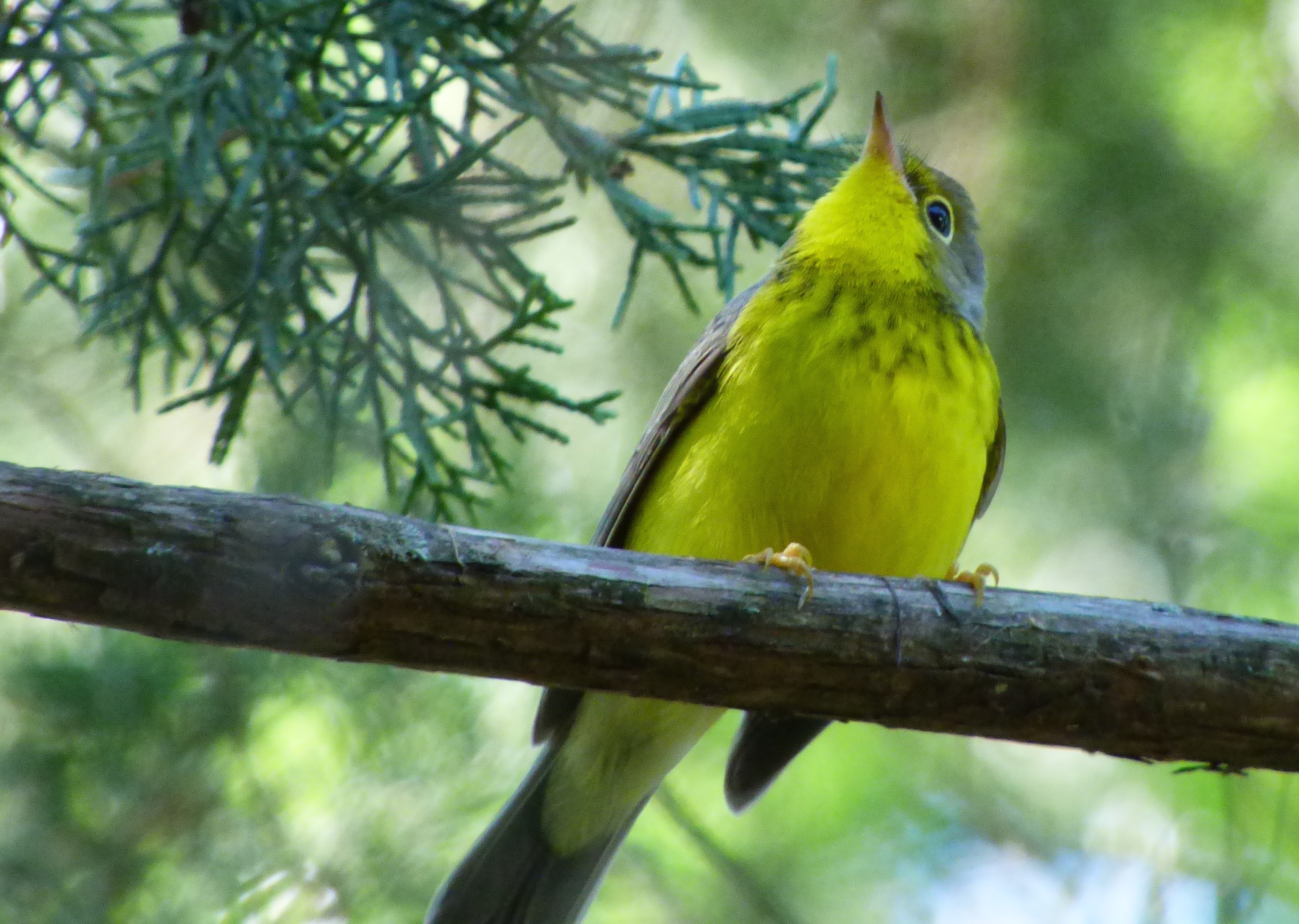
This Canada Warbler is just one of the disturbingly wide variety of warblers showing up in brother Phil’s backyard this year. Photo courtesy of Phil Ryan.
Phil has been emailing me rather frequently with news of another species he’s spotted dancing around in the upper branches of some tree. I’d love to challenge him on some of the identifications – Black-and-White Warbler, Northern Parula, Wilson’s Warbler and on and on – but he’s taking pictures. And some of them are really good. Damn digital cameras. Not to mention the lens extension Susan bought him.
Fine. Anyway, Phil and I did add a some terns to our Big Year list when we visited the newly renovated and expanded Haskell-Baker Wetlands on the south side of Lawrence, Kansas. Conveniently, all three tern species sat together on a little island in one of the pools, the Caspian Terns looking like giants, the Black Terns much smaller and the Least Terns tiny by comparison. The Black and Least Terns are new species to both of us, nice additions to our life lists. Two new ones at once makes for a pretty good day.
The year is winding down, but Phil has a trip to Florida planned for October. We’re hoping he’ll pick up a few additions while he’s there. There are plenty to choose from. We’d still like to hit at least 200 species before we wave goodbye to 2015.
Of course, there’s alway 2016. We’re not ruling out another shot at this ridiculous game, and we seem to be learning a few things. So why not?
Big Year species total for 2015: 190
 Bird Poop