We meet the world’s ugliest pigeons
Visualize this: You visit your local park, taking a seat on a comfortable bench. Soon the birds start to show up, flapping in to form a crowd on the ground in front of you, fighting with each other to claim the best spot. They know you. You’re the bringer of treats. In keeping with your role, you reach into the bag by your side and toss your flock a great big chunk of road kill – a particularly aromatic piece of armadillo, perhaps.
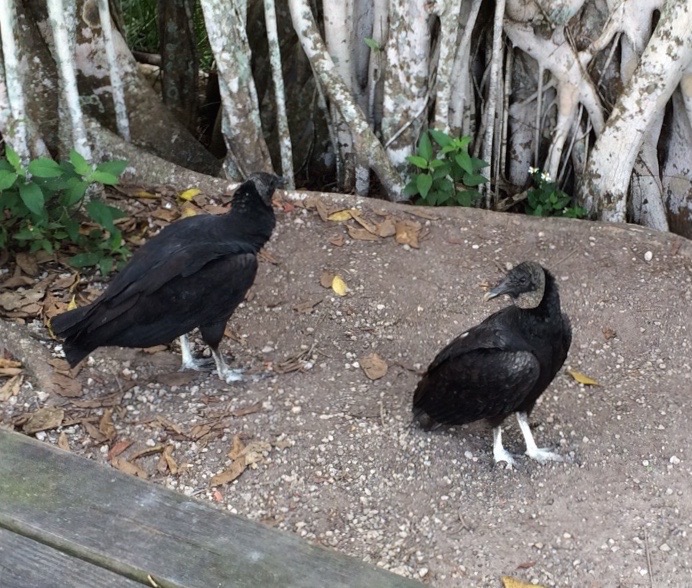
These Black Vultures are waiting for pumpkin spice armadillo in the Everglades.
Sound like fun? It’s a scene I could imagine unfolding this year in a couple of places: Everglades National Park in Florida and Bagnell Dam on the Lake of the Ozarks in central Missouri. Both areas boast large flocks of Black Vultures as well as Turkey Vultures which, with their naked red heads, are even less attractive than Black Vultures. The difference between the two species seems to be that Black Vultures are much more approachable – if approaching them is actually something you want to do.
Earlier this month, my wife Fran and I took a few days off to visit the Lake of the Ozarks, something we do two or three times a year. On the way down, we spotted quite a few of the aforementioned armadillos, dead by the side of the road, their little clawed feet sticking up stiffly in cartoony rigor mortis.
Although we spend some time at Bagnell Dam just about every time we go to see Great Blue Herons, Wood Ducks and other birds with a better public image, we’d never experienced anything to match the 200 to 300 Black Vultures soaring in the sky above and roosting in the trees there. A few of them behaved like many of their cousins in the Everglades – hanging out on the ground like pigeons and only attempting to fly when we really violated their personal space.
We watched the ones in the air, flapping faster than the Turkey Vultures that shared the airspace with them. Black Vultures are also smaller and show a bit of white on the wingtips, and then, of course, there’s that bald, black, wrinkly head. It serves the same purpose as Turkey Vultures’ naked pate by preventing all that nasty, rotting, maggot-infested, stinking dead flesh from collecting in their feathers. If you’re going to feast on carrion, you’d best put a premium on easy cleanup.
After watching the show for while, we left, driving up the steep road to reach the main highway that would take us across the dam and toward a much-anticipated happy hour. And there, at the top of the hill, were a Black Vulture and a Turkey Vulture on the ground, side by side. The Turkey Vulture sat back on its haunches (if birds can be said to have haunches) looking quite satisfied. If it had been featured in a Gary Larson “Far Side” cartoon, it would have been sucking on a toothpick. The Black Vulture was enthusiastically ripping into – guess what – a dismembered armadillo.
Here are the lessons learned from our little adventure:
- Armadillos and Black Vultures are moving north
- Black Vultures and Turkey Vultures enjoy dry-aged armadillo
- Turkey Vultures and Black Vultures don’t mind hanging out and eating together
- Turkey Vultures get first dibs at mealtime
- Black Vultures and Turkey Vultures look great when they’re far enough away and soaring
- Up close, Turkey Vultures and Black Vultures are disgusting
- Armadillos get run over with alarming frequency
- There are some experiences capable of taking all the happy out of happy hour
 Bird Poop