We’re reminded that life isn’t always pretty
Every once in a while, I’ll come across a murder scene in my backyard. Sometimes the victim’s remains will be gutted but otherwise intact. Other times, there will be nothing left but a few scattered feathers, often Mourning Dove gray and white. I’ve never witnessed the killing.
My neighborhood is rife with loose cats, some of them belonging to owners who don’t seem to understand the danger of foxes and automobiles, others rejected and dumped by callous people who should never be allowed near pets, still others the feral progeny of those thrown-away felines. Doubtless, these cats account for some of the dead birds. After all, they do have to eat.
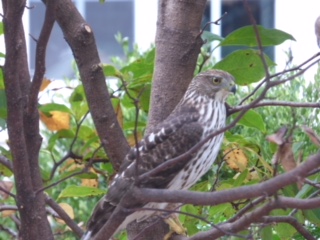
Cooper’s Hawk. Photo by Phil Ryan.
But I was reminded this morning that bird feeders don’t just attract songbirds and cats. They’re also feeding stations for hawks.
Around here, the hawks in question tend to be Cooper’s or Sharp-shinned. Today, it was a Cooper’s Hawk that sat on my back fence. There wasn’t another bird in sight. The House Sparrows, House Finches, American Goldfinches, Carolina Wrens, even the bolder Blue Jays had fled.
The hawk sat, its white breast and belly, speckled with reddish brown and looking like blood-spattered evidence of recent crimes, ruffled by a cold wind. Its large and powerful yellow claws gripped the wood, and its head with its black and yellow eyes and down-curved, sharp beak swiveled in search of prey. Then it turned its back, showing its banded tail, and flew, demonstrating by its size that it had to be a Cooper’s rather than its smaller look-alike, the Sharp-shinned.
On these winter days, with the wind strong and bitter, the temperature in the 20s and a light crust of ice covering last autumn’s leaves on the hard soil, the world seems particularly coarse and cruel. It’s the kind of day when a carcass on the ground seems appropriate, even right. The world can be, after all, a harsh place.
On the other hand, sighting the hawk had provided a moment of pure joy. It seemed that the wild had come to roost among the fences and the electrical cables and the backyard bird feeders. It was good to see and feel.
And now the backyard birds are returning to continue with their lives as if nothing has happened. After all, like the Cooper’s Hawk, they have to eat.
 Bird Poop