A sojourn south yields an avian treasure trove
It’s windy, sunny and comfortably warm here at Monteverde Lodge in the cloud-forested mountains of northwestern Costa Rica. The hows and whys of my journey to this place are of no importance, except to me. Let’s just say my brother Phil and I decided to visit a place he has been before and has come to love. Now, on our first full day here, I understand his affection.
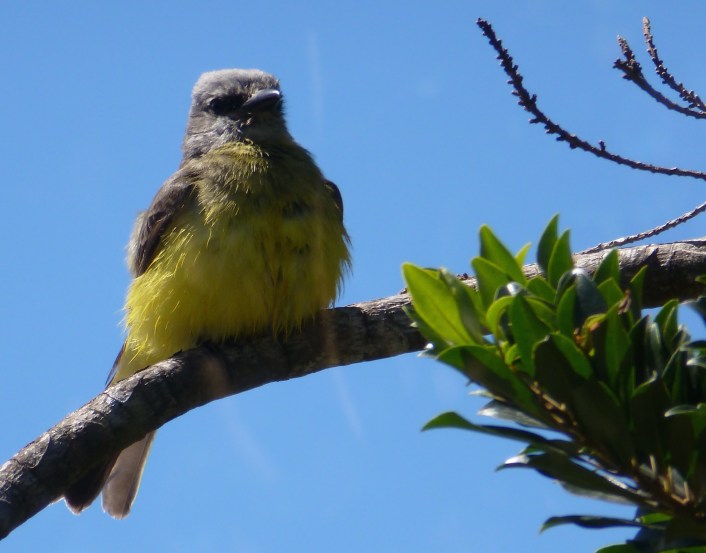
Tropical Kingbird taken through a window. Pardon the glare streaks.
I might talk more about the beauty of this small (about the size of Kentucky) Central American country, it’s society and geography in another post. At this moment, I want to talk about birds.
During the past 24 hours—10 of which were spent sleeping—I’ve added 17 species to my life list. And we have four days of guided birding ahead, as well as one more day on our own before we fly back to Kansas City. But, for now, let’s talk about yesterday afternoon and save the rest for other posts.
Riding the shuttle out of San Jose, I spotted a Mockingbird. But it wasn’t the Northern Mockingbird of my American Midwest experience. It had more white, especially on the tail, and it seemed bigger. It turned out to be a Tropical Mockingbird—my first life-list species of the trip.
Along the way from San Jose to Monteverde, we stopped at a little roadside café, a completely open affair that allowed the wind to blow through freely. To sit in that eatery enjoying a cup of Costa Rican coffee was to know beyond doubt why people want to live in the tropics.
Out on the lawn, a Clay-colored Thrush, Costa Rica’s national bird, picked at the ground just as an American Robin might. Life species #2. In a nearby tree sat a Tropical Kingbird, species #3. Then Phil and I looked up to find a large white bird that we originally thought was another gull we couldn’t ID. (We both think gulls are the devil’s spawn when it comes to identification.) Later that evening, though, Phil had an inspiration and found the White-tailed Kite in our old-school field guide. There it was, species #4. We escaped being gulled by a slender-winged imposter.
A harsh rattling spun our heads in another direction as a Hoffman’s Woodpecker demonstrated the species’ affinity for open areas and gardens. The golden wash over the head and nape made identification easy—species #5.
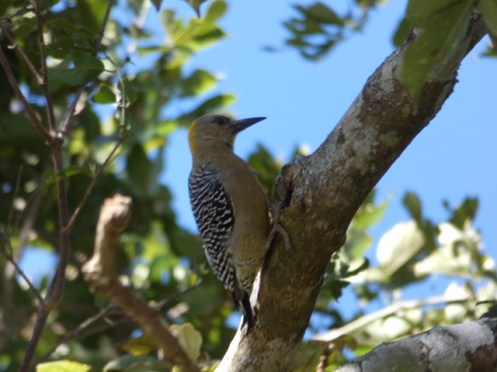
Hoffman’s Woodpecker. Photo courtesy of Phil Ryan.
Then we were off for the long and rough ride up to the lodge, something I’ll doubtless describe in more painful detail another day. By this time, the shuttle driver, Alba, had begun to warm to birding and birdwatchers. At one point, she cried out, “What’s that?” as a flock of White-throated Magpie-Jays, their topknots (like those on Gambel’s Quail) and magnificent long tails waving in the wind, landed noisily in two trees beside the mountain road, becoming species #6. In all the commotion, their crazy name suddenly seemed less crazy.
After what seemed (no, actually was) hours, we reached Monteverde Lodge in Santa Elena. The first day had come to a close, and we were exhausted. We’re exhausted again tonight, our second day, but tomorrow beckons, and sleep might be a little slow coming. Perhaps a nice cold Manhattan, up, in a martini glass, will help.
 Bird Poop