The birds of “Discovery”—Clark’s Nutcracker
This is the fifth in a series of posts focused on the birds featured in my new novel, Discovery. Look for another one each week.
Thanks to allaboutbirds.org, courtesy of the Cornell Lab of Ornithology, I now know that the Lewis and Clark expedition in 1804-1806 added just three bird species to the North American count. Seems pretty paltry given the amount of ground Merriwether and William covered during their trip. Still, I was pleased to learn that the Clark’s Nutcracker is named after William Clark, who spotted it in the summer of 1805 and at first thought it was a woodpecker. Now it carries a bit of history on its flight through the high mountains of the American west.
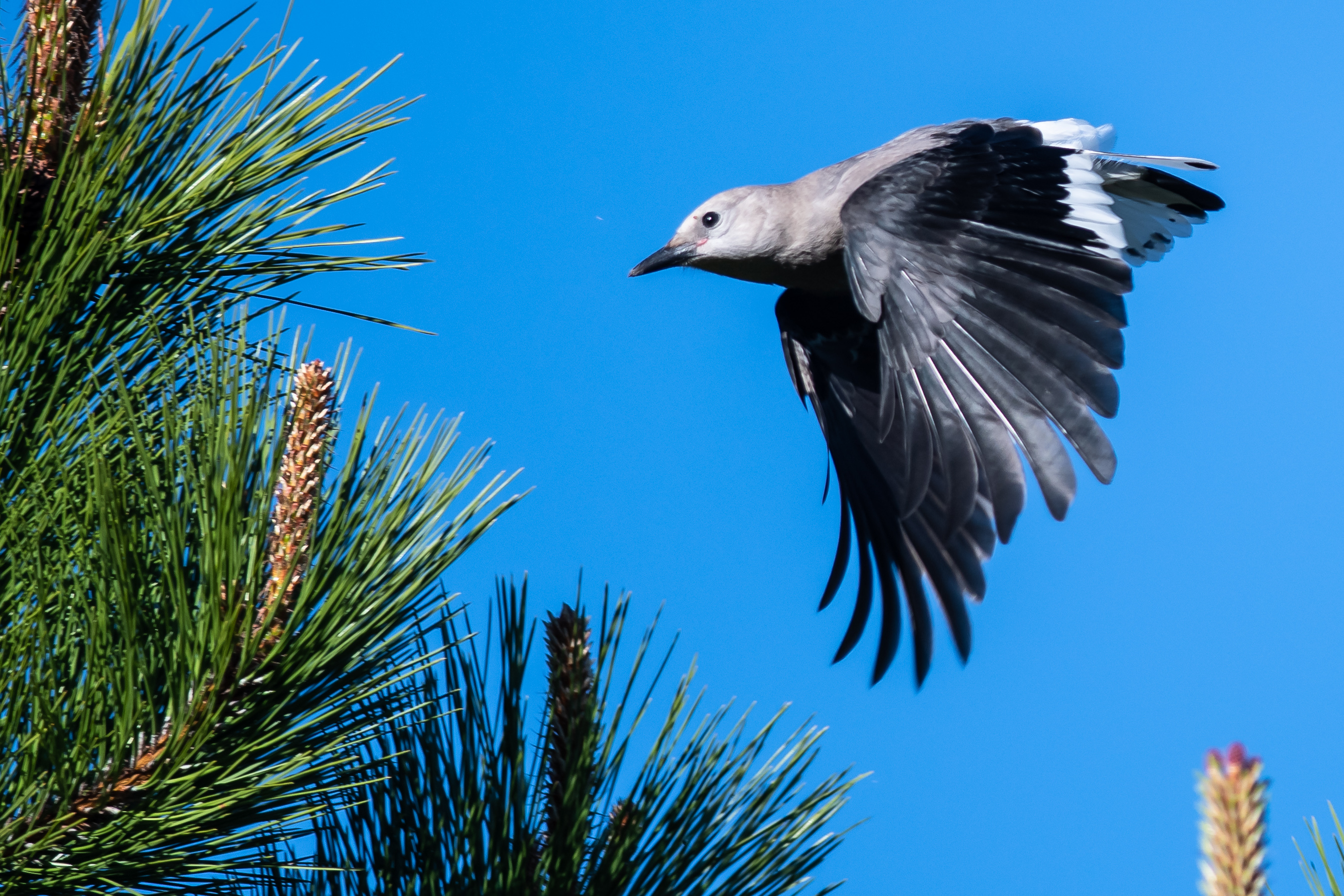
Like their relatives, the jays and crows, nutcrackers can hardly be called songsters. Their rattling squawks echoing from the cliffs don’t dazzle with their beauty. On the other hand, when it’s flying, the Clark’s Nutcracker is, as the photograph here shows, a wonder in black, white and gray. It resembles a woodpecker a little bit because of its undulating flight. I wonder if its heavy, pointed bill might also have had something to do with Clark’s mistake. The bird uses it to dig seeds out of pine cones and crack the shells.
Speaking of seeds, nutcrackers have a unique feature. Like squirrels, they possess a storage pouch. However, unlike the rodents’ cheek pockets, the Nutcracker’s is under its tongue. It can carry up to 90 seeds to stow away for the cold, snowy mountain winters. Having caches of seeds strewn about the mountainside is one reason these hardy birds are able to get a jump start on the breeding season, nesting as early as January or February.
The other reason winter breeding works for nutcrackers is pretty remarkable. Males of the species share egg-sitting duty. They even develop a brood patch, just like the females, so they’re not only able to keep the eggs warm but also split the time spent food-gathering.
Clark’s Nutcrackers like the thin mountain air. They’re often found near timberline, hanging out high in the pines or flying in a small group known as a “booby,” “ballet” or “suite,” among others. I get the “ballet” because they’re rather graceful flyers. “Suite” is less descriptive, and “booby” makes no sense to me at all. Maybe someone can explain it.
Found year-round in the western mountains, Clark’s Nutcrackers rarely stray east as far as Kansas, Missouri, Iowa and Minnesota. I’ve seen them only in Colorado, but if one decides to pay a visit to Missouri, I’ll be happy to see it. It will remind me of hikes in the magnificent high country to the accompaniment of that awful squawking.
 Bird Poop