The birds of “Discovery”—Violet-green Swallow
This is the eleventh in a series of posts focused on the birds featured in my new novel, Discovery. Look for another one each week. And watch for the book when it’s released March 28, 2025, from Better Than Starbucks Publishing, betterthanstarbucks.org.
You would be excused for thinking of the Violet-green Swallow as the jewel among its kind. The name is appropriate, at least for the male, with its almost iridescent green across the shoulders, down the back and over the head, along with the wash of violet on the wings and descending from the base of the tail. It looks like some mad artist decided to throw paint around and created astonishing beauty out of colors that shouldn’t go together.
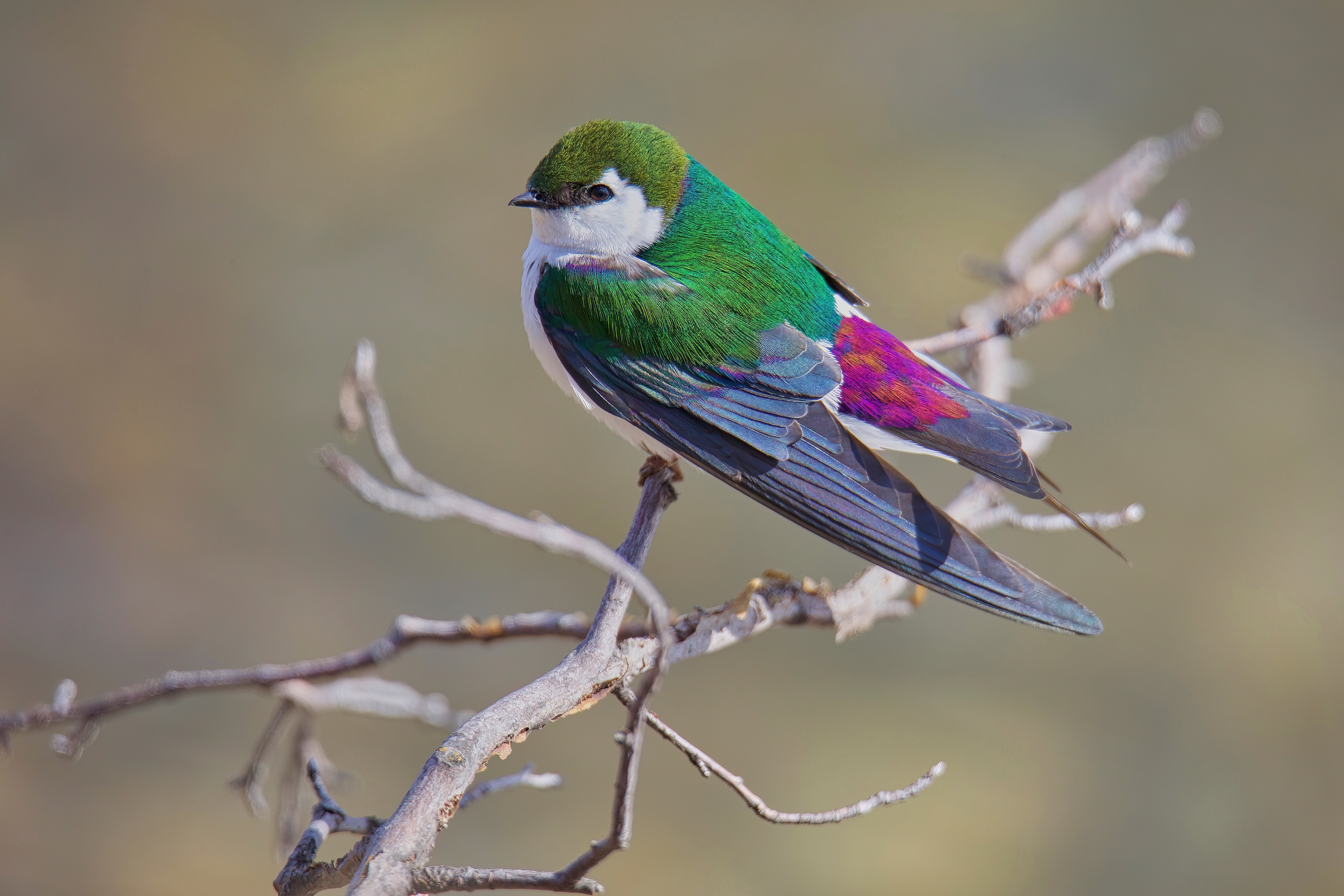
You might not agree, and I don’t care. I’ve made my stand.
Leaving aside this small swallow’s pulchritude, the bird has some other things going for it. It’s fast, for one thing. According to allaboutbirds.org, it can fly 28 mph, which compares favorably with the notoriously speedy Peregrine Falcon. Of course, you have to take into account, that this is the falcon’s speed when its just ambling along at its normal flight rate. When it “stoops” to capture its prey—most often another bird—the dive can reach about 240 mph. A Violet-green Swallow would be left in the dust or maybe be lunch.
Like other swallows, the Violet-green puts on an acrobatic show when its in the air. The ability to twist and turn comes in handy for a bird that depends on flying insects for food. Perhaps it’s also an asset when Peregrine Falcons and other hungry predators get too close.
Unlike some other birds—Cuckoos and Cowbirds come to mind—Violet Green Swallows do not lay their eggs in other bird species’ nests and leave them for strangers to raise their kids. In fact, in one documented instance, a pair of swallows helped a pair of Western Bluebirds with their chicks, guarding the nest and taking care of the babies. When the young bluebirds left for college, the swallows took over the nest and raised their own brood.
Gives co-parenting a whole new meaning. I love allaboutbirds.org and its fun facts.
In the summer, you’ll find Violet-green Swallows throughout much of the western continental United States, as well as western Canada and much of Alaska. Some of them make a year-round home along the California coast.
Wherever Violet-green Swallows are and whatever they’re up to—breeding, feeding, migrating, just hanging out—they want to do it in groups, sometimes of several hundred. They like to nest in cavities, so that puts them in competition with other cavity-nesting birds like House Sparrows, a species transplanted from Europe that has taken the nation by storm. Fortunately, the number of cavities seems adequate to give most pairs a place to have babies and keep the sky populated with winged jewels.
 Bird Poop