The birds of “Discovery”—Great Horned Owl
This is the thirteenth, and last, in a series of posts focused on the birds featured in my new novel, Discovery. Watch for the book when it’s released March 28, 2025, from Better Than Starbucks Publishing, betterthanstarbucks.org.
I’m not sure whether I scared it off or it decided at the last second that its iprey was too big to carry off, but the owl swooped in for the grab and, like a plane whose pilot suddenly decides not to land, rocketed back up and disappeared into the darkening forest. The intended victim was one of our two family dogs. Looking back, I’m not certain it was a Great Horned Owl. It might have been a Barred Owl, which is a little bit smaller. They both look plenty big at dusk or dawn when they’re hunting in the semidarkness.
Our dog’s close encounter with two sets of powerful talons ended well for the intended victim who seemed oblivious to the bloody fate it had just escaped. The Great Horned Owl’s soft feathers render it almost silent in flight. Its relatively short wings make it easier for it to avoid obstacles in the forest where it usually prefers to live and hunt.
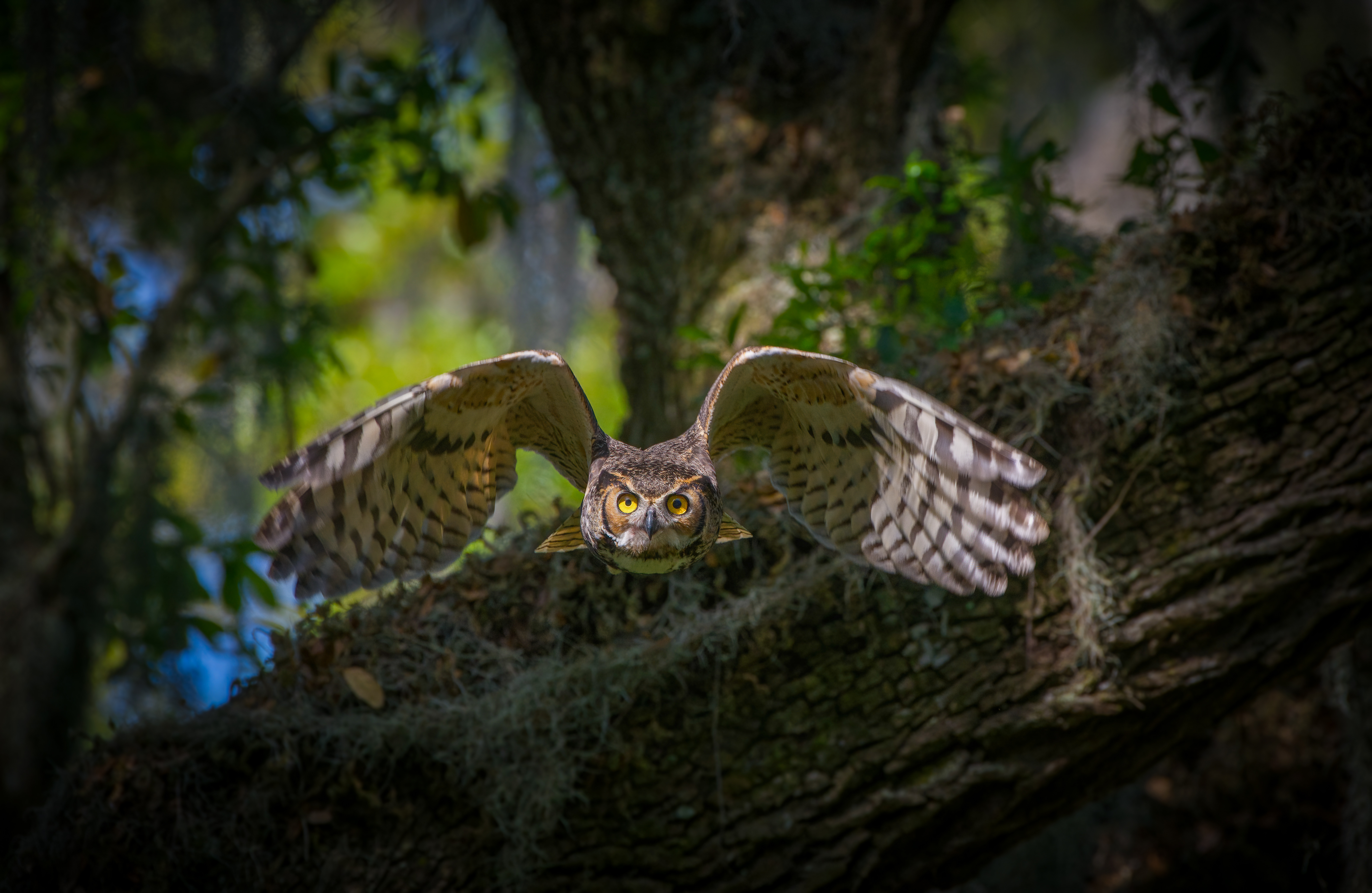
The objects of Great Horned Owls’ hunting trips don’t usually include dogs, but they do enjoy a meal of smaller animals, like rodents. (By the way, did you know that ground squirrels in California have started hunting, killing and eating voles, which are also rodents? Owls should be careful. The little hairy-tailed rats might turn on them one day. Come to think of it, maybe we should be a bit wary, too.) These owls will also prey on other large birds, such as Ospreys and other owls.
One of the Great Horned Owl’s favorite foods is the American Crow, and the crows work hard to keep the predators at bay. They’ll gather in large groups when they detect an owl’s presence and harass the enemy for hours on end, according to allaboutbirds.org.
You’ll find Great Horned Owls just about anywhere in North America, including cities and suburbs. They even live in the desert, where they’ll use cliff ledges for nesting.
If you’re out on your deck on a February or March night and hear a scream, wait a little bit before calling the cops. If you hear a similar scream again, it’s likely a female Great Horned Owl defending her nest. These birds don’t care how cold it is. They’ll lay eggs in the middle of winter anyway.
You’ve probably heard that owls can turn their heads 180 degrees. It’s certainly true of the Great Horned Owl. It can spin its noggin a little more than halfway through an Exorcist rotation. One thing it can’t do is give you the side-eye. It’s eyes, while great for seeing at night, can’t move in their sockets.
So, if your pet weighs five pounds or less, it’s probably not a good idea to let it outside alone. Great Horned Owls are fond of cats, in particular. And keep an eye out for gangs of carnivorous ground squirrels. Death by hungry squirrel is just too embarrassing.
 Bird Poop