This is the fourth in a series of posts focused on the birds featured in my new novel, Discovery. Look for another one each week.
“Dark-eyed Junco” serves as a catch-all name for six forms: Slate-colored, Oregon, Pink-sided, Red-backed, Gray-headed and White-winged. They all belong to one species, but they look different — kind of like people. In the U.S., they share quite a bit of territory, particularly in the western states. Except for the Slate-colored form. It’s around all year in much of the west, upper midwest and east from Maine as far south as Tennessee and North Carolina. During the winter it pretty much takes over the whole country.
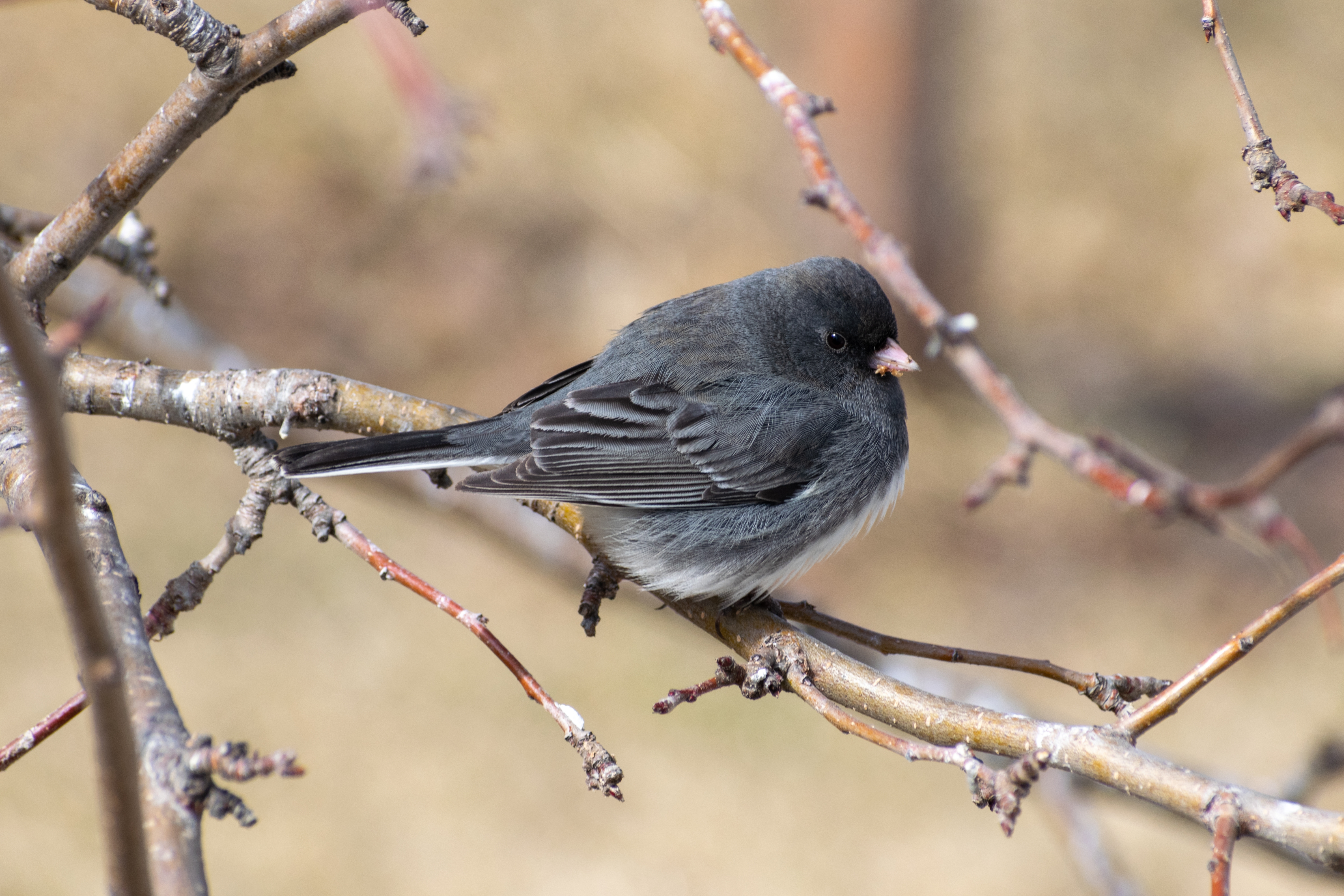
Here in Missouri, we’re mostly restricted to the Slate-colored form. Rarely, Oregon and Gray-headed Juncos will show up on somebody’s list, but that doesn’t happen very often. To make matters more confusing, the Slate-colored form has a couple of variants: one with white wing bars that make the bird resemble a female white-winged form and another that looks a little like the Oregon form. One thing that all these Juncos share is white on the outer edges of the tail that flashes when they fly. At least when you see one, you can be fairly sure it’s some kind of Junco, and you’ll be safe listing it as Dark-eyed, should you be foolish enough to take up birding and become a list keeper.
Just to keep the accounting honest, the Dark-eyed Junco isn’t the only member of the family. The Yellow-eyed Junco makes its way, barely, into the southeastern corner of Arizona and, rarely, into a small area of southwestern Texas.
The upshot: If you like walking in open woodlands where small ground-feeding birds have some cover if they need it, you’ll probably find Dark-eyed Juncos of one kind or another. Especially in winter, they like to gather in small flocks to feed, and you’ll know them by that white on the tail. It’s like a flag waving to announce their presence.
Even if you don’t like a stroll in the woods, a backyard feeder will suffice to attract juncos. I find that a wild bird mix or thistle seed bring them in reliably. The other birds spill enough seed to keep them happy on the ground.
This is the third in a series of posts focused on the birds featured in my new novel, Discovery. Look for another one each week.
Especially in the central and southern Rocky Mountains, Steller’s Jays are the clowns of the bird world. More than any other variety of this species (of which there are several, ranging from Mexico to Alaska), these noisy fools even look the part. They seem to be wearing streaks of white grease paint on their faces in an effort to appear as ridiculous as possible. They’re also loud and prone to blatant thievery, practically stealing food off picnickers’ plates.
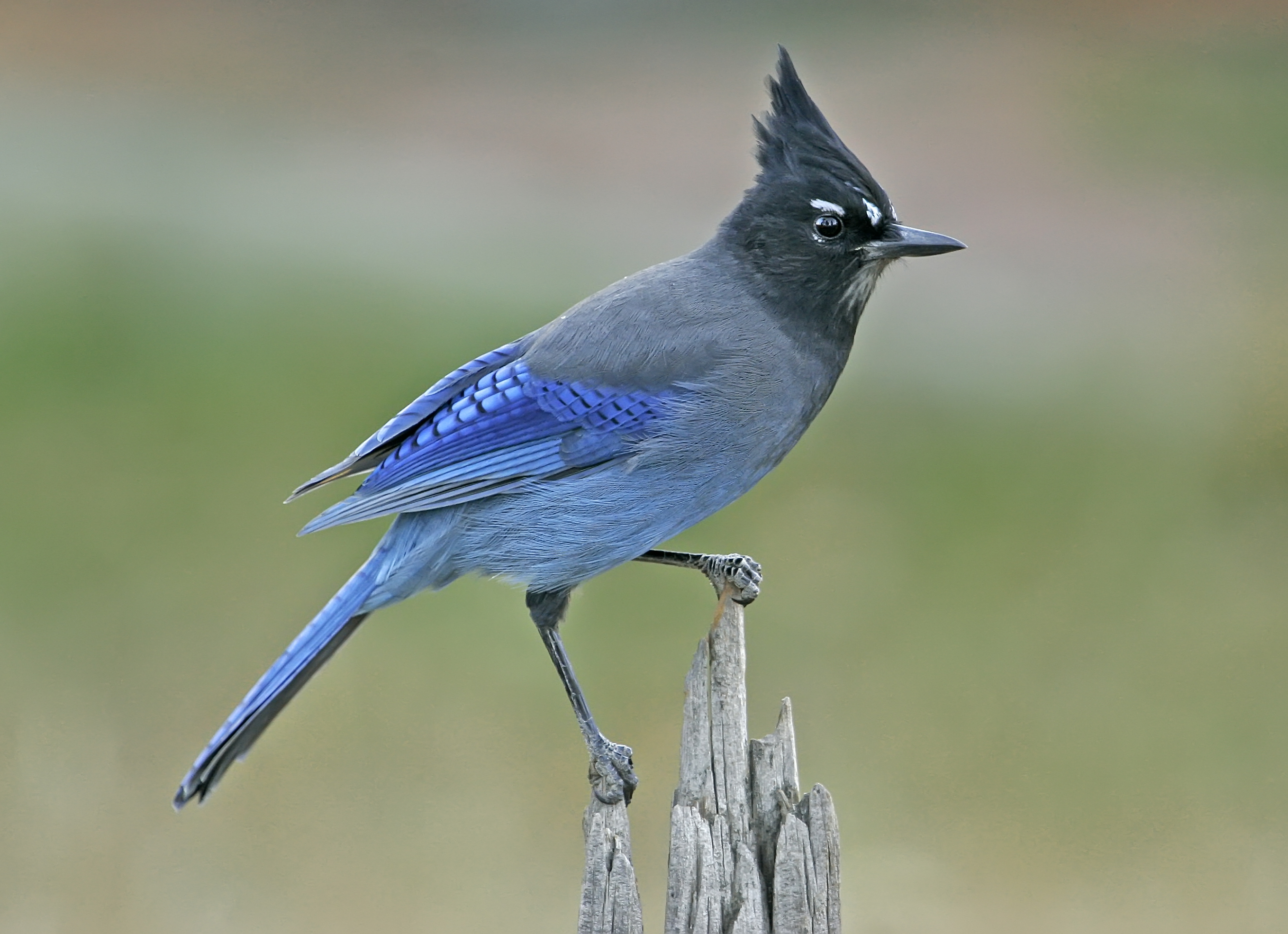
Of course, Steller’s Jays are also beautiful. Their black head, topped with a large crest, and dark blue body make them almost regal, until their squawking and pushy behavior ruin the illusion. Their thieving extends beyond picnic raids to nest robbing where they indulge their appetite for eggs and young birds. The occasional adult small bird also finds its way onto the menu.
That big crest, by the way, is unusual among jays. In North America, only the Steller’s Jay and the Blue Jay have one. Steller’s Jays hold the bragging rights for the bigger crest.
For years, when I kept a list of the birds I saw on trips to my family’s cabin in Colorado, I’d misspell “Steller’s” as “Stellar’s.” Come to find out, it’s a common mistake, so I don’t feel so bad. In fact, according to the folks at allaboutbirds.org, a great site offered by the Cornell Lab of Ornithology, “Steller’s Jays have the dubious honor of being one of the most frequently misspelled names in all of bird watching.” Nice to know I’m just another ignoramus.
Turns out, Georg Steller (no, I didn’t misspell Georg; he was Russian) discovered these jays in 1741 on an island off Alaska. He’s also the namesake of the Steller’s Sea Lion and the Steller’s Sea-Eagle, among other species.
One more thing about Steller’s Jays from allaboutbirds.com: they like to mimic sounds from other birds, including chickens, as well as cats, dogs and squirrels. They’ll even copycat machines. Personally, I’d like to hear a chainsaw. Given Steller’s Jays’ typical vocalizations, it wouldn’t be too much of a stretch.
This is the second in a series of posts focused on the birds featured in my new novel, Discovery. Look for another one each week.
Like teenagers on prom night, Black-billed Magpies can be loud, boisterous and unruly. But, unlike said teenagers, both male and female magpies are always dressed to the nines. (Quick side note: Nobody knows why “dressed to the nines” means somebody is in perfect style. One guess is that it has to do with tailors needing nine yards of cloth to make a really nice suit. Maybe that’s where the phrase “the whole nine yards” comes from, too.)

Anyway, back to magpies. As the photo above shows, they are beautiful birds — not just because of their stunning black and white plumage, but also because of the blue to greenish blue sheen that shows in the right light. These birds live year-round throughout a large range in the western U.S., nearly to the Pacific coast. In California, the Yellow-billed Magpie occupies a limited area along the central coast and, to the north, somewhat inland.
I’ve mentioned that magpies tend to be loud and boisterous. They like to get together in groups, again like teenagers, and squawk about whatever magpies have to squawk about. It’s no surprise that they’re members of the family Corvidae, which includes jays, crows and ravens. All the species in this family are considered songbirds for some reason, even though they couldn’t carry a tune in a dump truck. (Another quick side note: The idiom is usually “can’t carry a tune in a bucket,” but that seems a little too little to illustrate the situation fairly.)
In flight, magpies look a little like a swimmer doing the butterfly stroke, but it’s hard to pay attention to the mechanics of the motion with all that magnificent black-and-white plumage flashing by. It’s been said that magpies strut when they’re on the ground, as if they know full well how beautiful they are. Of course, that’s ridiculous. They strut because they’ve got the good life figured out. For example, they don’t limit their diet to a few kinds of seeds or small, defenseless animals. Instead, they eat just about anything, from grain to bugs to rotting carcasses. And they act like they enjoy it. They make lots of raucous noise. They flap those wonderful wings in joy. And, when they walk, they strut like they really are beautiful geniuses.
If I seem down on magpies, I’m not. I admire them greatly. Like their fellow corvids — the crows, ravens and jays — they’re smart. Like most jays, they’re handsome. Like cockroaches and rats, they’re able to adapt and thrive. And, frankly, I’d rather see kitchens and alleys infested with magpies.
This is the first in a series of posts focused on the birds featured in my new novel, Discovery. Look for a new one each week.
The first time I met a Mountain Chickadee — and I use the word “met” purposely — I might have been 10 years old. My father had recently bought a fishing cabin on 31 acres near Crestone, Colorado, an old mining town where no one mined any more. The town is located on the eastern edge of the San Luis Valley, an extensive area of rabbit brush where mountain streams go to die, sinking into the sandy soil a few miles after reaching the valley floor. The cabin, surrounded by piñon, juniper and stately pine trees, with a rushing stream behind it, offered an almost Eden-like contrast to the starkness of the valley. The first thing that struck me — and I never grew tired of the sensation — was the rich aroma of mountain woodland and waterside vegetation.
And from that first visit, I’ve been charmed by Mountain Chickadees. I can’t say whether they behave the same way throughout their range, but the birds around that cabin seemed curious about us and unafraid. They’d move down from branch to branch, seeming to purposely come so close we could almost touch them. No other species of chickadee in my experience has shown that — for lack of a better word — friendliness.
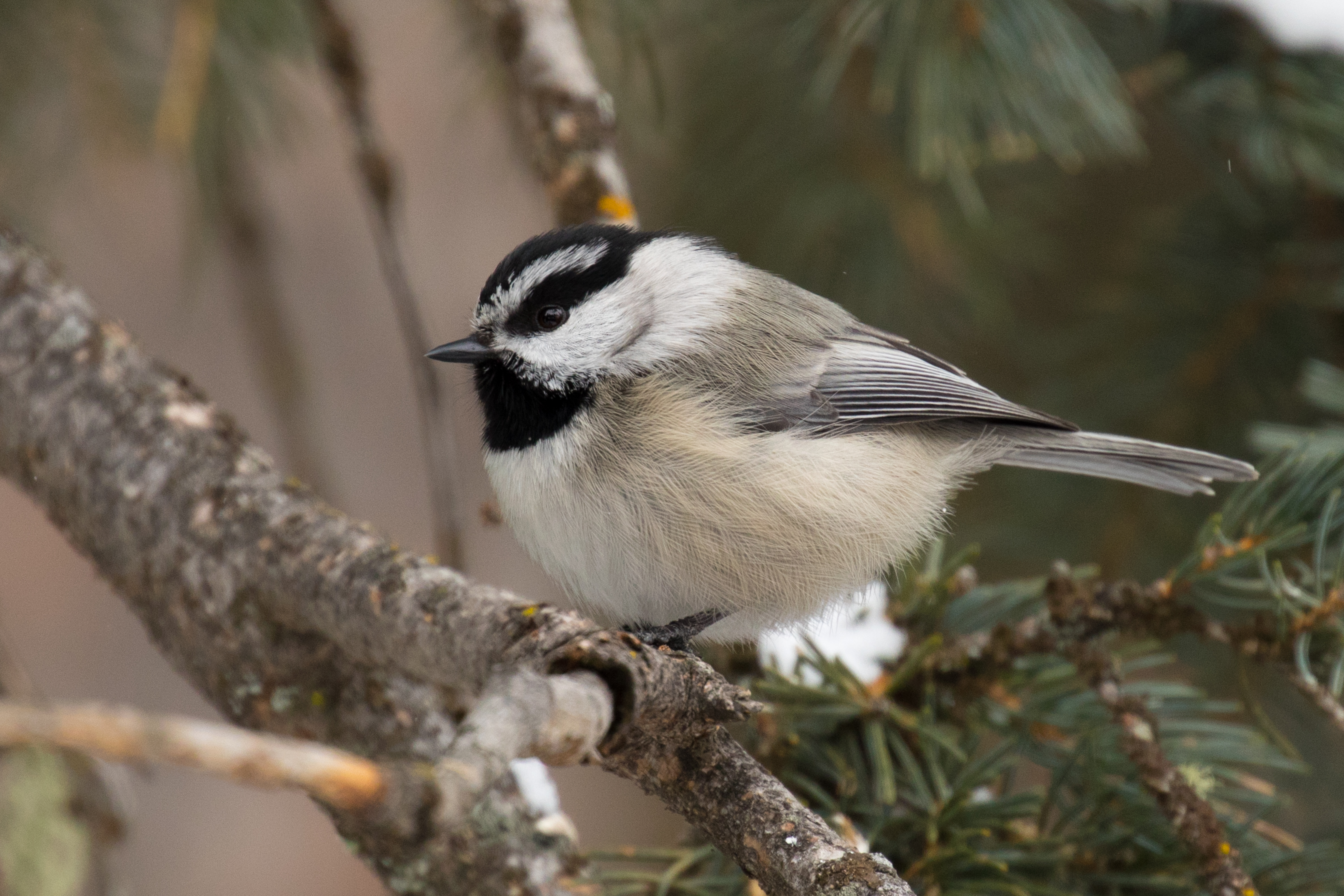
Of course, friendly isn’t the same as stupid. They’d come just so close and no closer. But if we looked carefully, we could see our faces reflected in their black eyes.
Here in Missouri, Black-capped Chickadees are common visitors to bird feeders, and Carolina Chickadees occur in the southeastern part of the state. I’m most familiar with the Black-capped because I live in northwest Missouri. We can hear their chick-a-dee-dee-dee call at home and when we’re birding in the field. But we won’t find them hopping down from a higher branch just to say, “Hello.” They’re a bit shyer than their mountain cousins.
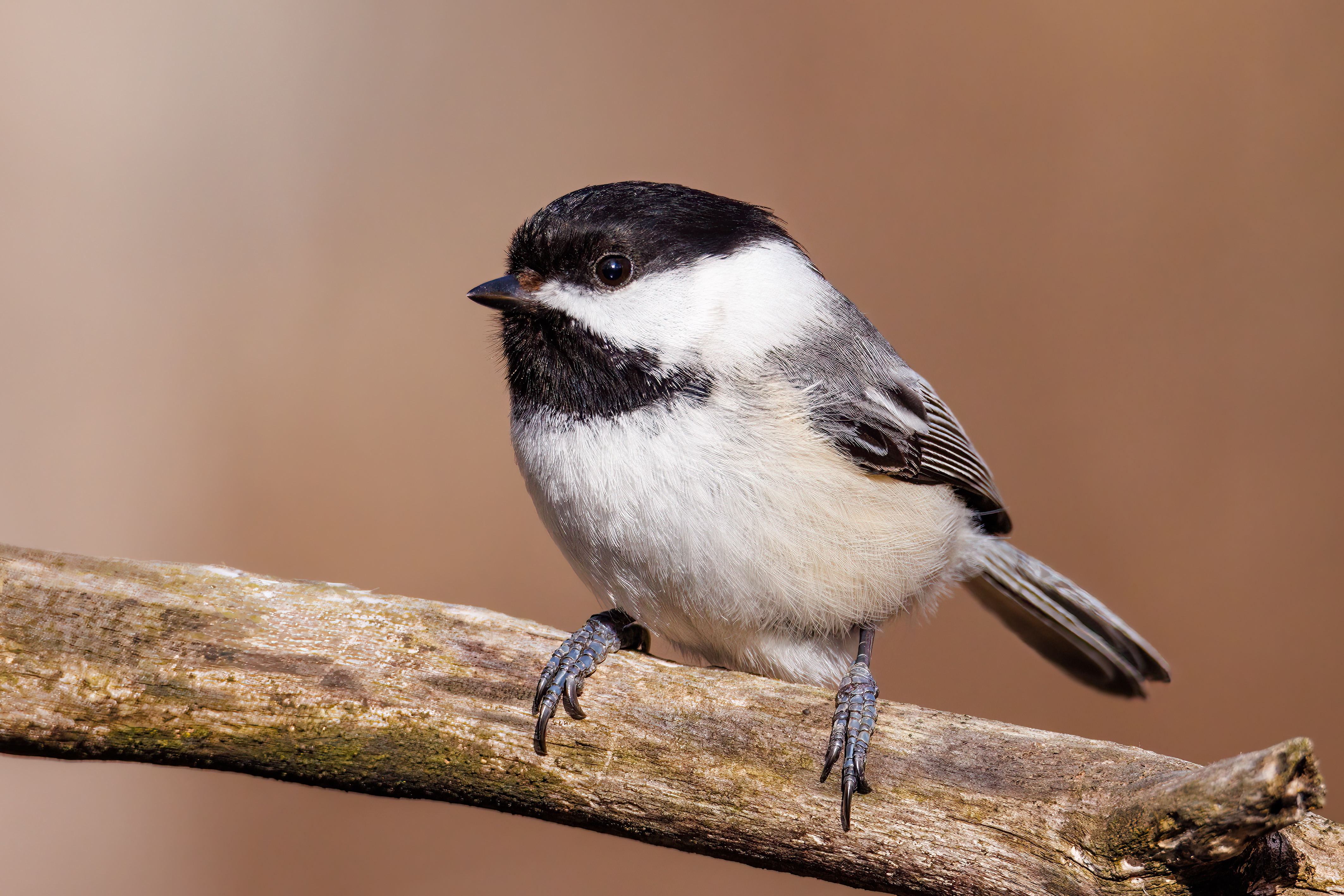
Mountain Chickadees and Black-capped Chickadees look enough alike to make identification a bit tricky. However, the Black-capped’s cap is solid black. The Mountain’s cap shows a white stripe that looks like an eyebrow. For what it’s worth, the Mountain’s beak is a little thinner, but I keep leaving my micrometer at home, so that’s of little use, and it’s hard to get the birds to sit still for a measurement anyway.
Helen Bryan, the heroine of Discovery, shares my enjoyment of these chickadees. Everyone who appreciates birds and gets a chance to visit the Mountain Chickadee’s habitat should have a chance to experience their fearlessness and their collegiality.
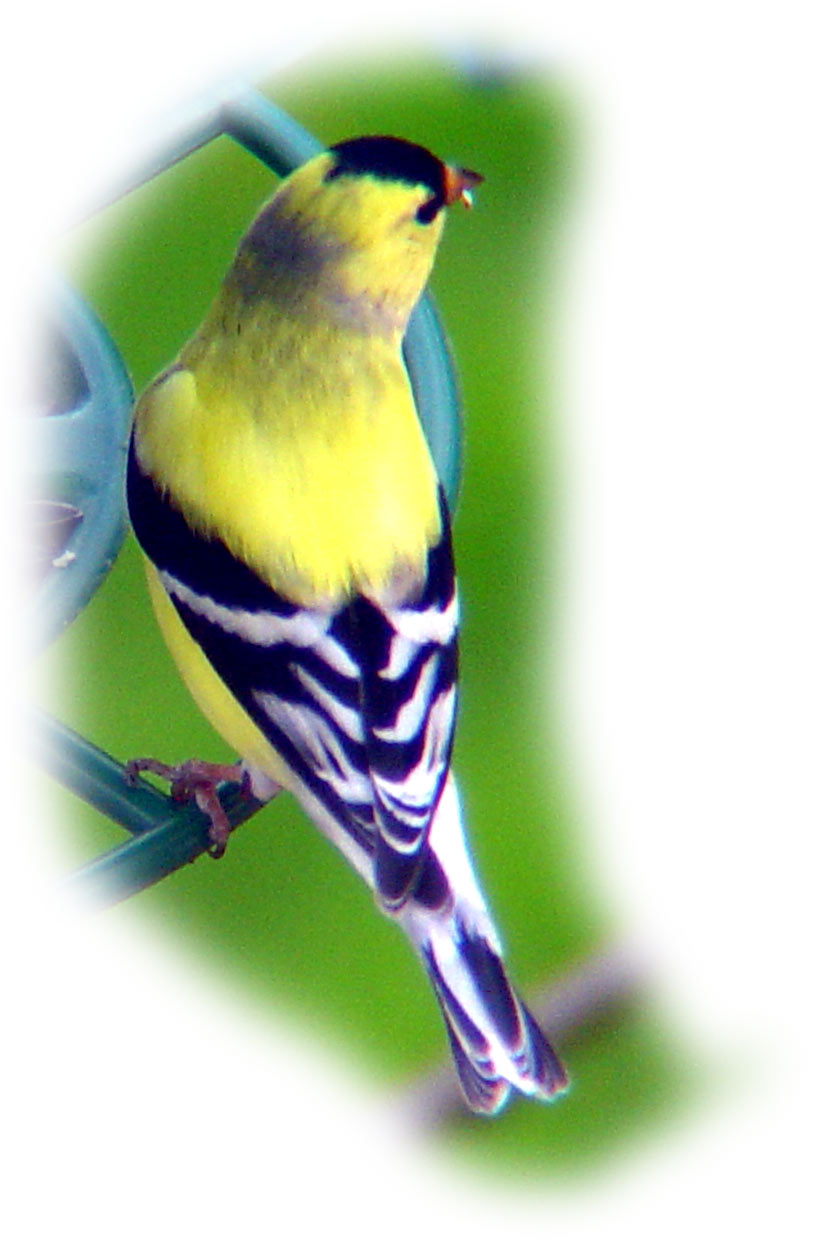
It’s difficult not to wax precious when discussing American goldfinches. Let’s face it. They’re adorable. Sporting a perfect combination of bright yellow, black and white, the males decorate a thistle seed feeder like an array of constantly moving five-inch ornaments. When they’re disturbed, they fly away with a high-pitched twitter that sounds more like a giggle than a cry of fright.
Here in Missouri, goldfinches stay all year. As cooler weather arrives, the males lose their bold coloration and look more like the females and juveniles. It’s a different kind of beauty but more in keeping with the changing season. Like the females all year round, the males take on a soft, yellow-brown suede look with off-white wing bars.
In the spring, especially, when the young goldfinches are still too stupid to recognize the threat a human might pose, they’ll sometimes let me come within inches. This nonchalance is perhaps the best indication that the bird is a juvenile. Adult females and juveniles resemble each other, but the older females possess a life-extending lack of trust. I sometimes wonder, when I’m sitting on the porch step, letting a young bird dance around my feet, if I’m perhaps opening it to an unfortunate encounter down the road. Maybe I should give it a good scare — serve as a surrogate meanie, so to speak.
I agree. Thanks, Colin.
Now we interrupt this post for a quick commercial.
My new novel, Discovery, from BTS Publishing, is available for order. It’s the story of 85-year-old Helen Bryan, who one morning receives a disturbing message from her dead husband and sees a bird she thinks could belong to a new species. These events set her on a journey that tests the limits of her physical and emotional endurance.
For more about Discovery, visit discoverynovel.com. To order your copy, go to betterthanstarbucks.org.
They’re called peeps. They’re those little creatures that skitter across stinking mud flats, sticking their bills deep into the slime in the worst kind of weather. Why we’ve named them peeps must have something to do with the high-pitched, taunting calls they make as they go about their foraging.
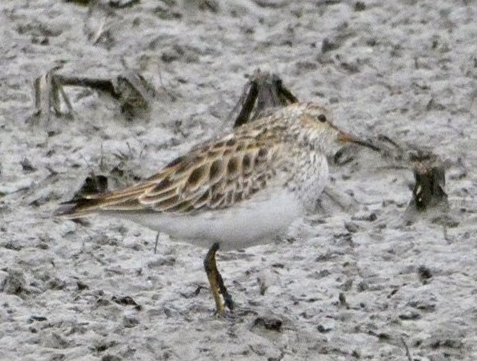
The notorious peep known as Least Sandpiper in its natural habitat–muck and stench. Photo courtesy of Phil Ryan.
I say this after watching a variety of peeps at work on a beautiful, calm morning at Quivira National Wildlife Refuge in the middle of Kansas. Quivira is a wetland–a big one–made up of salt marshes. On this particular morning, the marshes didn’t smell bad, and a purple/red/yellow sunrise painted the landscape under a blue sky striped with cirrus clouds, so the whole thing was a pretty pleasant exercise. Just say I was so surprised at how pleasant it was that it brought to mind the many other times I’ve been out when the situation was anything but.
Anyway, peeps include seven species–three new-world sandpipers–Semipalmated, Western and Least–and four old-world stints–Red-necked, Little, Temminck’s and Long-toed. Like many other shorebirds, the peeps poke and stir the muck looking for delicacies. It’s a project that occupies a good deal of their time because either they have trouble finding enough to sate their appetite or they’re just insatiable.
Now you’d think that their running around willy-nilly on the mudflat would make them fairly easy to identify. Just find the right field marks–bill length, leg color, prominent markings–and Bob’s your uncle. You would think incorrectly. Especially in the late summer and fall, they’re maddening.
(By the way, this phrase, “Bob’s your uncle,” has puzzled me for years. Where did it come from? Why would you use it when you can just say, “And there you are?” Why did I just use it? Who cares?)
Part of the problem isn’t the peeps’ fault. It’s the wind–at least at Quivira and nearby Cheyenne Bottoms National Wildlife Refuge. Sometimes it blows just enough to make it slightly difficult to keep a spotting scope from shaking . Other times, the gales are almost enough to knock you down. You have to lean in at a 30+-degree angle to stay upright, which might not be so bad if the wind were steady but, of course, it’s not, so just when you get a bead on one of the little . . . things, the blow dies down a bit and you topple forward, losing not only your poise and dignity but also any hope of figuring out what you’ve been looking at because your sudden motion has scared everything away.
But back to peeps. Late in the year, they all look alike. Even the field guides admit it. Even the professionals confess to it. For example, the Semipalmated Sandpiper can best be identified by its semipalmated feet. What in the name of all bunions and toenail fungi is a semipalmated foot?
Well, I’ll tell you. Its toes are partially webbed. Think about that for a second. Then add the italics. Its toes are partially webbed. I call on all bunions and toenail fungi once again–please explain to me how I’m supposed to discern webbing on toes the size of ants at 300 feet, in the wind, when said feet are either buried in muck or moving at breakneck speed?
Thank you. I rest my case. Peeps are poops.
It’s windy, sunny and comfortably warm here at Monteverde Lodge in the cloud-forested mountains of northwestern Costa Rica. The hows and whys of my journey to this place are of no importance, except to me. Let’s just say my brother Phil and I decided to visit a place he has been before and has come to love. Now, on our first full day here, I understand his affection.
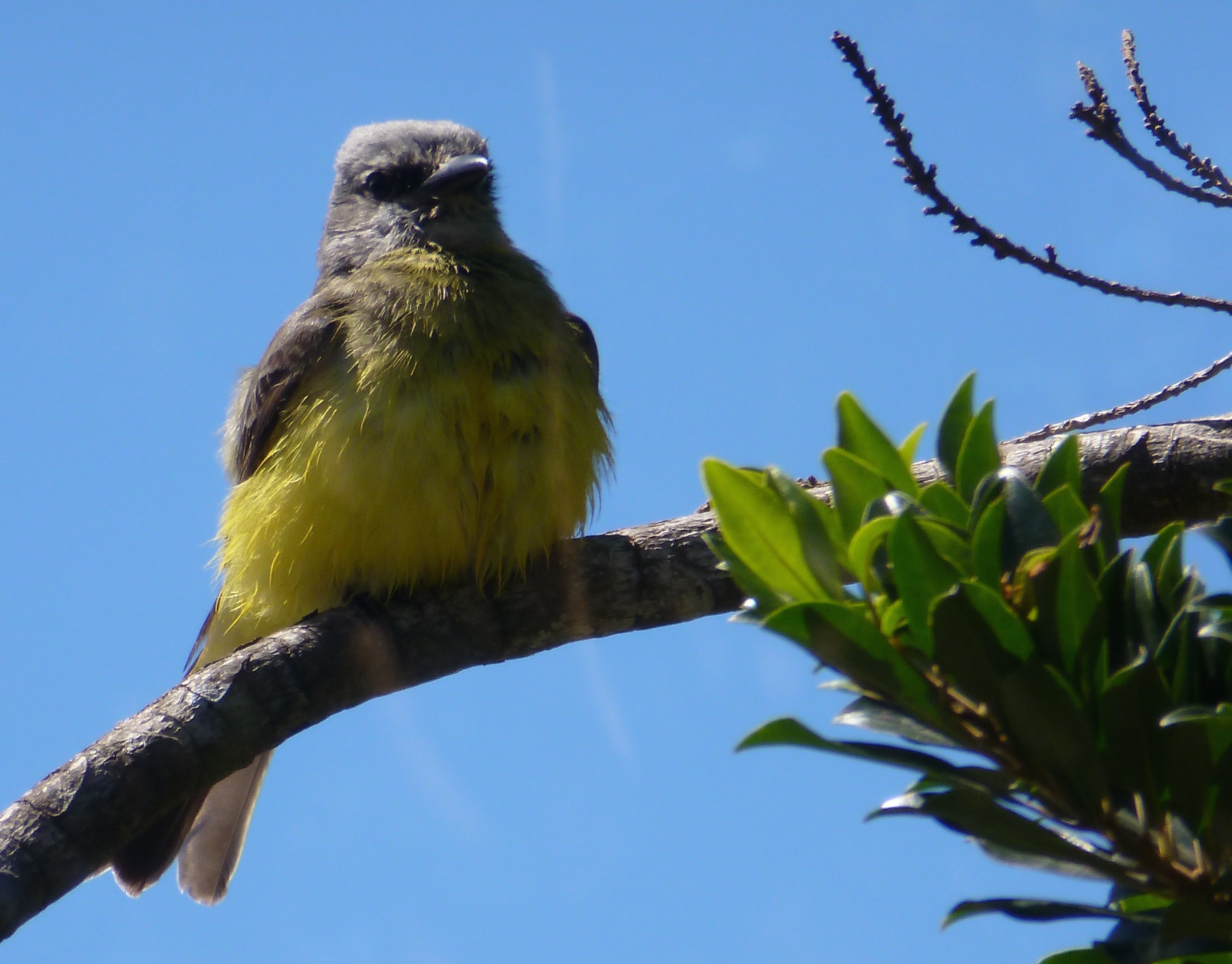
Tropical Kingbird taken through a window. Pardon the glare streaks.
I might talk more about the beauty of this small (about the size of Kentucky) Central American country, it’s society and geography in another post. At this moment, I want to talk about birds.
During the past 24 hours—10 of which were spent sleeping—I’ve added 17 species to my life list. And we have four days of guided birding ahead, as well as one more day on our own before we fly back to Kansas City. But, for now, let’s talk about yesterday afternoon and save the rest for other posts.
Riding the shuttle out of San Jose, I spotted a Mockingbird. But it wasn’t the Northern Mockingbird of my American Midwest experience. It had more white, especially on the tail, and it seemed bigger. It turned out to be a Tropical Mockingbird—my first life-list species of the trip.
Along the way from San Jose to Monteverde, we stopped at a little roadside café, a completely open affair that allowed the wind to blow through freely. To sit in that eatery enjoying a cup of Costa Rican coffee was to know beyond doubt why people want to live in the tropics.
Out on the lawn, a Clay-colored Thrush, Costa Rica’s national bird, picked at the ground just as an American Robin might. Life species #2. In a nearby tree sat a Tropical Kingbird, species #3. Then Phil and I looked up to find a large white bird that we originally thought was another gull we couldn’t ID. (We both think gulls are the devil’s spawn when it comes to identification.) Later that evening, though, Phil had an inspiration and found the White-tailed Kite in our old-school field guide. There it was, species #4. We escaped being gulled by a slender-winged imposter.
A harsh rattling spun our heads in another direction as a Hoffman’s Woodpecker demonstrated the species’ affinity for open areas and gardens. The golden wash over the head and nape made identification easy—species #5.
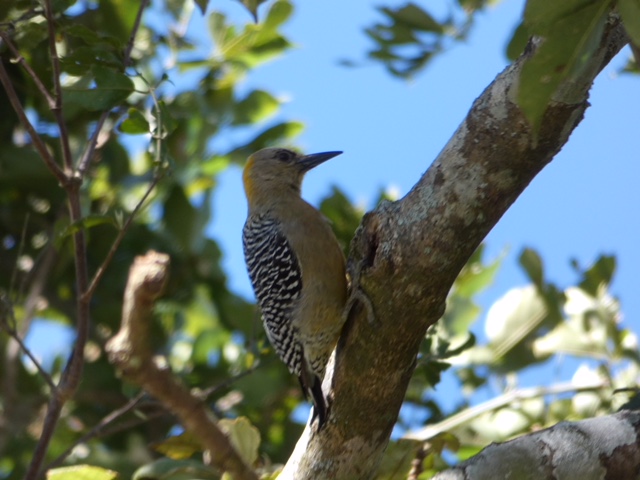
Hoffman’s Woodpecker. Photo courtesy of Phil Ryan.
Then we were off for the long and rough ride up to the lodge, something I’ll doubtless describe in more painful detail another day. By this time, the shuttle driver, Alba, had begun to warm to birding and birdwatchers. At one point, she cried out, “What’s that?” as a flock of White-throated Magpie-Jays, their topknots (like those on Gambel’s Quail) and magnificent long tails waving in the wind, landed noisily in two trees beside the mountain road, becoming species #6. In all the commotion, their crazy name suddenly seemed less crazy.
After what seemed (no, actually was) hours, we reached Monteverde Lodge in Santa Elena. The first day had come to a close, and we were exhausted. We’re exhausted again tonight, our second day, but tomorrow beckons, and sleep might be a little slow coming. Perhaps a nice cold Manhattan, up, in a martini glass, will help.
Every once in a while, I’ll come across a murder scene in my backyard. Sometimes the victim’s remains will be gutted but otherwise intact. Other times, there will be nothing left but a few scattered feathers, often Mourning Dove gray and white. I’ve never witnessed the killing.
My neighborhood is rife with loose cats, some of them belonging to owners who don’t seem to understand the danger of foxes and automobiles, others rejected and dumped by callous people who should never be allowed near pets, still others the feral progeny of those thrown-away felines. Doubtless, these cats account for some of the dead birds. After all, they do have to eat.
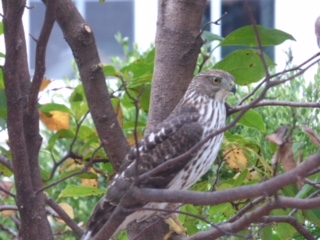
Cooper’s Hawk. Photo by Phil Ryan.
But I was reminded this morning that bird feeders don’t just attract songbirds and cats. They’re also feeding stations for hawks.
Around here, the hawks in question tend to be Cooper’s or Sharp-shinned. Today, it was a Cooper’s Hawk that sat on my back fence. There wasn’t another bird in sight. The House Sparrows, House Finches, American Goldfinches, Carolina Wrens, even the bolder Blue Jays had fled.
The hawk sat, its white breast and belly, speckled with reddish brown and looking like blood-spattered evidence of recent crimes, ruffled by a cold wind. Its large and powerful yellow claws gripped the wood, and its head with its black and yellow eyes and down-curved, sharp beak swiveled in search of prey. Then it turned its back, showing its banded tail, and flew, demonstrating by its size that it had to be a Cooper’s rather than its smaller look-alike, the Sharp-shinned.
On these winter days, with the wind strong and bitter, the temperature in the 20s and a light crust of ice covering last autumn’s leaves on the hard soil, the world seems particularly coarse and cruel. It’s the kind of day when a carcass on the ground seems appropriate, even right. The world can be, after all, a harsh place.
On the other hand, sighting the hawk had provided a moment of pure joy. It seemed that the wild had come to roost among the fences and the electrical cables and the backyard bird feeders. It was good to see and feel.
And now the backyard birds are returning to continue with their lives as if nothing has happened. After all, like the Cooper’s Hawk, they have to eat.
My wife Fran says that seeing hundreds of thousands of Lesser Sandhill Cranes dancing in the fields and flying in ragged V formation overhead renews her faith in nature’s endurance. She’s easier to convince than I am, but it’s still an awe-inspiring sight. Even after making this pilgrimage to view the annual crane gathering along Nebraska’s Platte River between Grand Island and Kearney for 15 springs, I’m still filled with wonder at the sight.
This year, the weather cooperated throughout the three-day weekend we spent traveling and birding. Our first stop was Loess Bluffs National Wildlife Refuge (formerly Squaw Creek NWR). New to our 2017 bird list were Snow Geese whose thousands filled the air and massed on the pools with a few Ross’s Geese mixed in. The two species are easier to tell apart when they’re next to each other. The Ross’s is smaller and has a shorter bill, along with a more squared off “forehead.” Otherwise, they look the same to my eyes. We also added White Pelican and Wood Duck.
Pressing on, we hit the magic region west of Grand Island late in the afternoon, just as the cranes were flying in from the fields to their roosts on the Platte River’s sandbars. They come in flocks large and small from every direction, filling the sunset-burnished sky with their chortling call. When they’re on the ground and calling, you might imagine you’re listening in on the world’s biggest cocktail party.
Of course, cranes weren’t the only birds around, just the tallest. We picked up Double-crested Cormorants, Greater White-fronted Geese and two new sparrows, the Chipping and Harris’s. That brought the final total of new species to eight–fewer than we wanted, to be sure, but still enough to bring the total list to 81. So we’re on par with last year.
There’s a lot to say about the area where the Sandhill Cranes stop on their way to nesting grounds in the far north. The Iain Nicolson Audubon Center at Row Sanctuary is not only a good birding spot but also a shining example of hay bale architecture. Who’d have guessed fodder could look so good?
Kearney itself offers the Museum of Nebraska Art, which has a new exhibit or two every time we visit. (Yes, there are real artists in and from Nebraska. Quit being such a chauvinist.) Also look for wineries. (There you go again). I’m no expert (he said, modestly), but them midwestern grapes ferment pretty good.
The spring crane convention in Nebraska has become an international attraction, so finding a hotel room from late February through early April can be a challenge. Make your reservation months in advance if you want to spend a few days enjoying one of the world’s most spectacular avian events.
So far, so good. Our bird species count for this year is running about even with last year at 72. But, with any luck, things are about to jump.
My wife Fran and I are taking off for northern climes (well, Nebraska) this Friday with a stop at Loess Bluffs National Wildlife Refuge (formerly Squaw Creek National Wildlife Refuge, a name change we fully support, by the way). Our final destination is Kearney, Nebraska, and the stopover grounds for upwards of 500,000 Lesser Sandhill Cranes. It’s a pilgrimage we make almost every year to welcome spring.
Usually at this time of year, the Loess Hills refuge is a pretty good hunting ground (metaphorically speaking, of course). We’ve seen Trumpeter Swans, White Pelicans, Ross’s Geese and quite a few ducks on previous forays. We never know what to expect, and that’s half the fun, except when the pools are bare and the wind is blowing a gale. Our confidence is high, though.
I’ll have more to tell–for better or worse–in a longer entry when we get back.
 Bird Poop