You’d think a man in his mid-60s would have the sense to know when to call it quits. For three years I’ve started this blog and then let it slide. Other things, such as the lack of enough imagination to come up with topics, have always gotten in the way.
As a blogger, I’ve been a bust. But here I am again, telling myself I really can make regular entries. If I don’t, I’ll just have to hide my head in a virtual paper bag and live with the shame of it.
On the brighter side, my brothers Phil and Terry and I have upped our bird species count each year (with the help of other family members, on occasion). In 2014, we saw 179 species. The next year it was 202, and in 2016, we picked up 250. As of today–February 25–we’re at 53, exactly the same as last year at this time. So there’s at least a chance we’ll outdo 2016.
I’m going to stop here because I don’t want to strain myself and not be able to generate another entry because of exhaustion. Best to take these things one small step at a time.
After some 33 years in Kansas City, I’ve adopted a simple approach to dealing with life at the northern reaches of the border between Missouri and Kansas:
I’m always glad to see the snow.
And equally happy to watch it go.

I’m interpreting this as Lucy’s “I’m upset because the sidewalks are icy” look. But I’ll consider other opinions.
We haven’t had all that much of the white stuff this season, but what we have had – maybe two inches around New Year’s Day – stayed too long, thanks to an Alberta Clipper that dropped temperatures into the single digits. This situation upset our dog Lucy, who is used to a 45-minute walk each morning without the hazards of ice on the sidewalk. At least, I think it upset her. It’s kind of hard to tell.
Anyway, we ended our second attempt at a Big Year in 2015 with 202 species. That’s 23 better than 2014. And yes, we’re going to try again this year. However, I’m not going to call it a Big Year. That seems somewhat overblown, not to mention redundant. It’s a little ridiculous to call every year a Big Year – kind of cheapens the whole concept.
As of today, January 12, we’ve built a list of 30 species. At this rate, we should end the year with 780.
Ha, ha.
It’s always so exhilarating in the beginning. Every day brings several new birds, mostly seen hanging around the feeders – Downy and Red-bellied Woodpeckers, Northern Flickers, American Goldfinches, House Sparrows, House Finches, Dark-eyed Juncos, Mourning Doves and on and on. We’ve even had a Northern Mockingbird at the heated birdbath.
Then it starts to slow down and slow down some more. Brother Phil’s backyard additions – a Yellow-bellied Sapsucker, for instance – stop coming. Brother Terry in Colorado helps with western birds like a Common Raven, but the drought ensues. Finally, we actually have to leave the house to see something new. So we begin to venture forth into the cold, hard winter.
Surf Scoters have been reported on the lake at Shawnee Mission Park on the Kansas side of the state line. Maybe we can catch them before they leave. And maybe we won’t have to get out of the car to see them.
Visualize this: You visit your local park, taking a seat on a comfortable bench. Soon the birds start to show up, flapping in to form a crowd on the ground in front of you, fighting with each other to claim the best spot. They know you. You’re the bringer of treats. In keeping with your role, you reach into the bag by your side and toss your flock a great big chunk of road kill – a particularly aromatic piece of armadillo, perhaps.
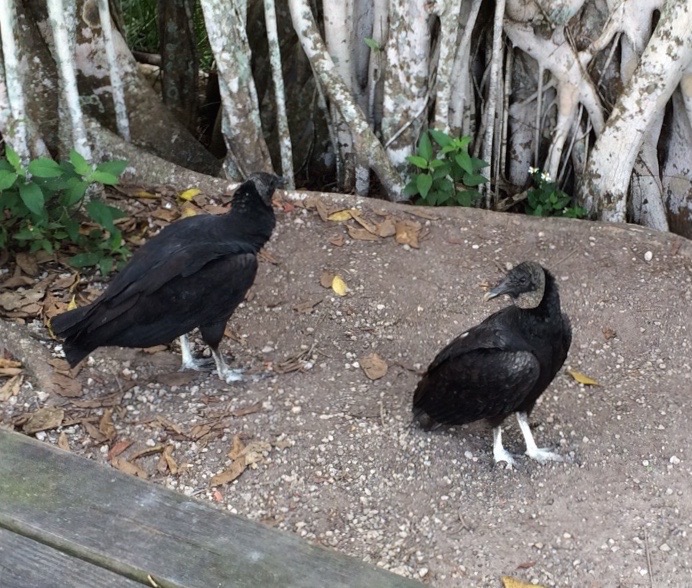
These Black Vultures are waiting for pumpkin spice armadillo in the Everglades.
Sound like fun? It’s a scene I could imagine unfolding this year in a couple of places: Everglades National Park in Florida and Bagnell Dam on the Lake of the Ozarks in central Missouri. Both areas boast large flocks of Black Vultures as well as Turkey Vultures which, with their naked red heads, are even less attractive than Black Vultures. The difference between the two species seems to be that Black Vultures are much more approachable – if approaching them is actually something you want to do.
Earlier this month, my wife Fran and I took a few days off to visit the Lake of the Ozarks, something we do two or three times a year. On the way down, we spotted quite a few of the aforementioned armadillos, dead by the side of the road, their little clawed feet sticking up stiffly in cartoony rigor mortis.
Although we spend some time at Bagnell Dam just about every time we go to see Great Blue Herons, Wood Ducks and other birds with a better public image, we’d never experienced anything to match the 200 to 300 Black Vultures soaring in the sky above and roosting in the trees there. A few of them behaved like many of their cousins in the Everglades – hanging out on the ground like pigeons and only attempting to fly when we really violated their personal space.
We watched the ones in the air, flapping faster than the Turkey Vultures that shared the airspace with them. Black Vultures are also smaller and show a bit of white on the wingtips, and then, of course, there’s that bald, black, wrinkly head. It serves the same purpose as Turkey Vultures’ naked pate by preventing all that nasty, rotting, maggot-infested, stinking dead flesh from collecting in their feathers. If you’re going to feast on carrion, you’d best put a premium on easy cleanup.
After watching the show for while, we left, driving up the steep road to reach the main highway that would take us across the dam and toward a much-anticipated happy hour. And there, at the top of the hill, were a Black Vulture and a Turkey Vulture on the ground, side by side. The Turkey Vulture sat back on its haunches (if birds can be said to have haunches) looking quite satisfied. If it had been featured in a Gary Larson “Far Side” cartoon, it would have been sucking on a toothpick. The Black Vulture was enthusiastically ripping into – guess what – a dismembered armadillo.
Here are the lessons learned from our little adventure:
- Armadillos and Black Vultures are moving north
- Black Vultures and Turkey Vultures enjoy dry-aged armadillo
- Turkey Vultures and Black Vultures don’t mind hanging out and eating together
- Turkey Vultures get first dibs at mealtime
- Black Vultures and Turkey Vultures look great when they’re far enough away and soaring
- Up close, Turkey Vultures and Black Vultures are disgusting
- Armadillos get run over with alarming frequency
- There are some experiences capable of taking all the happy out of happy hour
The warblers seem to be headed south again, on their way to warmer climes after nesting up north, and they’re stopping with annoying frequency in my brother Phil’s backyard. Admittedly, he and his wife Susan have a pretty nice backyard with lots of trees of different species. And, of course, there are the bird feeders, although the warblers don’t seem to care about them very much – except, maybe, the pan of dead mealworms.
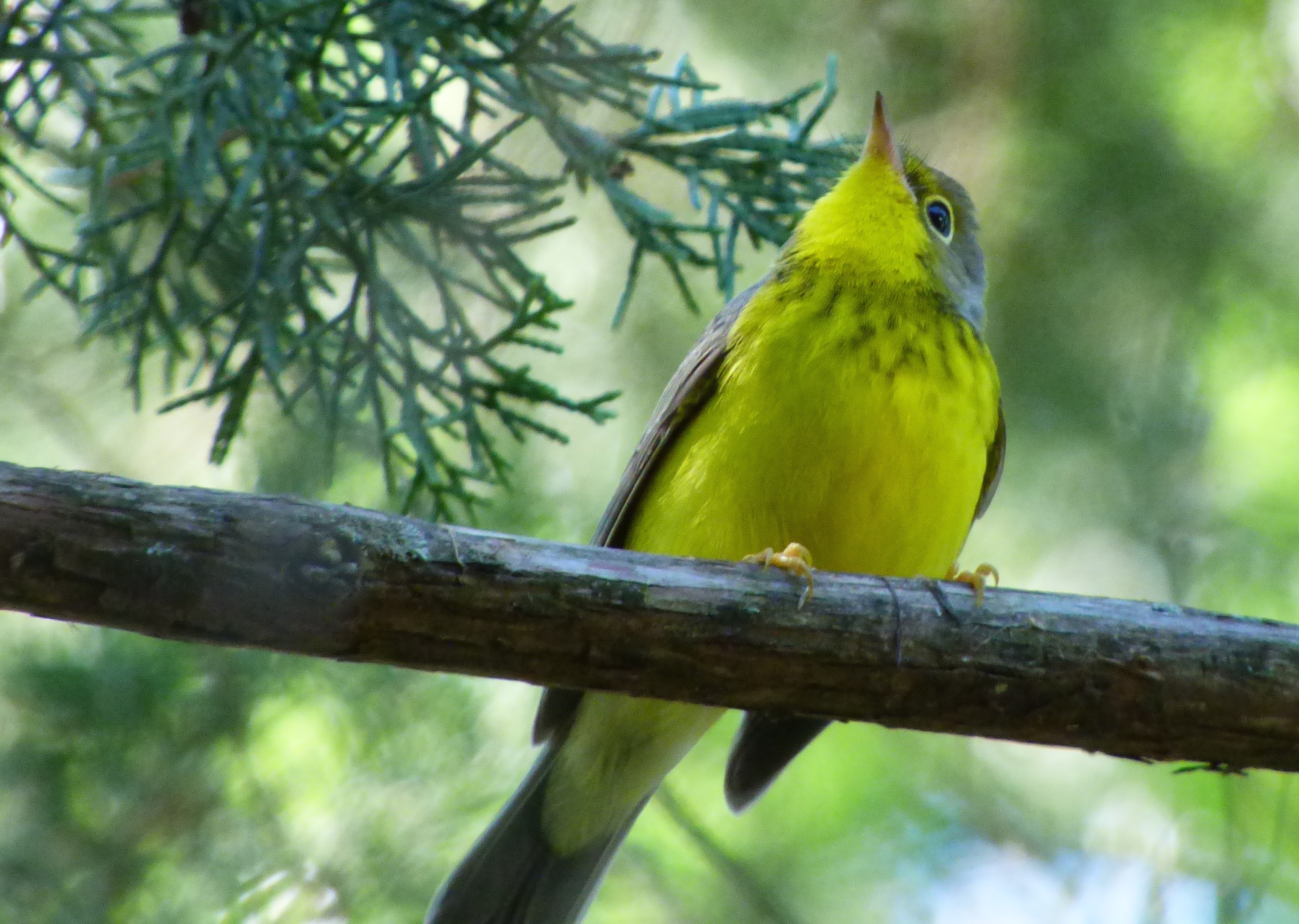
This Canada Warbler is just one of the disturbingly wide variety of warblers showing up in brother Phil’s backyard this year. Photo courtesy of Phil Ryan.
Phil has been emailing me rather frequently with news of another species he’s spotted dancing around in the upper branches of some tree. I’d love to challenge him on some of the identifications – Black-and-White Warbler, Northern Parula, Wilson’s Warbler and on and on – but he’s taking pictures. And some of them are really good. Damn digital cameras. Not to mention the lens extension Susan bought him.
Fine. Anyway, Phil and I did add a some terns to our Big Year list when we visited the newly renovated and expanded Haskell-Baker Wetlands on the south side of Lawrence, Kansas. Conveniently, all three tern species sat together on a little island in one of the pools, the Caspian Terns looking like giants, the Black Terns much smaller and the Least Terns tiny by comparison. The Black and Least Terns are new species to both of us, nice additions to our life lists. Two new ones at once makes for a pretty good day.
The year is winding down, but Phil has a trip to Florida planned for October. We’re hoping he’ll pick up a few additions while he’s there. There are plenty to choose from. We’d still like to hit at least 200 species before we wave goodbye to 2015.
Of course, there’s alway 2016. We’re not ruling out another shot at this ridiculous game, and we seem to be learning a few things. So why not?
Big Year species total for 2015: 190
We had new windows installed throughout our 100+-year-old house a few years ago, including a fair-sized picture window in the dining room. We don’t see an ocean vista or mountain view through it, just a few feet of weedy ground, our air-conditioning unit, a wood fence and our neighbor’s house (which property, by the way, sports a Russian thistle tall enough to show a couple of feet above the six-foot fence). But that expanse of glass encouraged placement of a few birdfeeders, including one full of finch mix and another filled with sugar water. We also put out a potted plant that offers bright red blooms all summer (I’d identify that plant here, but I’m too lazy to look it up).
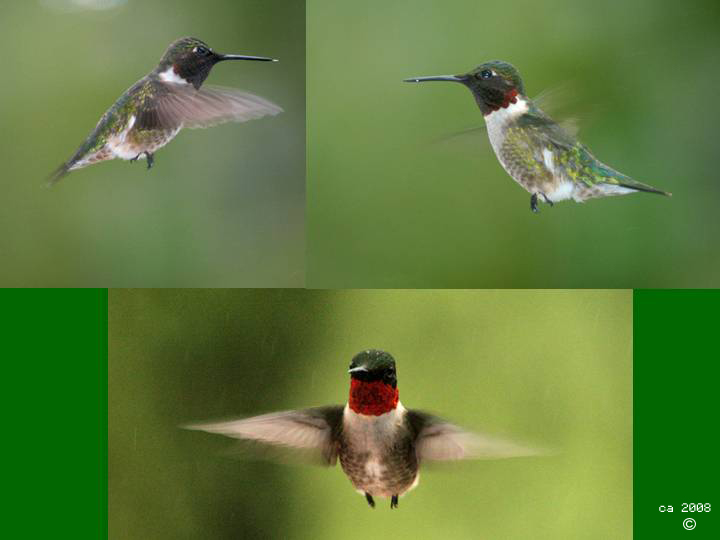
My friend Colin Andrews made these photos and put together this mug shot of a male Ruby-throated Hummingbird.
Throughout the season, the number and variety of birds visiting the feeder and cleaning up seed from the ground has grown. On any given day, we’ll spot 10 or 15 American Goldfinches, the occasional House Finch, five or six Mourning Doves, Blue Jays, Common Grackles, Downy Woodpeckers, American Robins, Red-bellied Woodpeckers, Northern Flickers, House Sparrows (of course) and, most rewarding of all, Ruby-throated Hummingbirds. We know of at least two who make regular visits, and there are probably more.
We’re not sure whether the two hummers we see are both female, or juvenile males or females. We’re just happy to see them. We’ve been trying for several years to attract the only species of hummingbird seen regularly in the eastern half of the United States without a lot of luck. Now we catch sight of them often as we pass the window.
So what’s the big deal about these little birds? Hummingbirds are just plain fun to watch. They’re unbelievably tiny, and their acrobatics are impressive, whether they’re hovering at the feeder or a flower or zipping to and fro as though they’re evading some invisible bogey bird, or maybe oversized bumble bee. Sometimes they’ll stop their blur-winged flight long enough to sit on a perch and sip the sugar water leisurely, but that lasts only a few seconds.
It’s always a surprise to see a hummingbird. I’m not sure why. After all, the Goldfinches are more spectacularly colorful, and the blue jays make a much louder and more frenetic entrance on our little stage. Maybe it’s the hummers’ sheer tinyness that does it or their quick comings and goings. Sometimes you can’t be sure, at least at first, whether you’re seeing spots before your eyes or a cicada buzzing by. Then you glimpse that long needle of a bill and the bird’s astonishing hover-craft, and all you can do is stand and stare, hoping it will stay around just a few moments longer.
This is the season when adding species to our Big Year list gets frustrating. We haven’t recorded many of the most common summer birds in Missouri and Kansas – Upland Sandpiper, Northern Bobwhite and a lot more – but the sightings don’t come as quickly and easily. We have to go farther afield to spot fresh feathers.
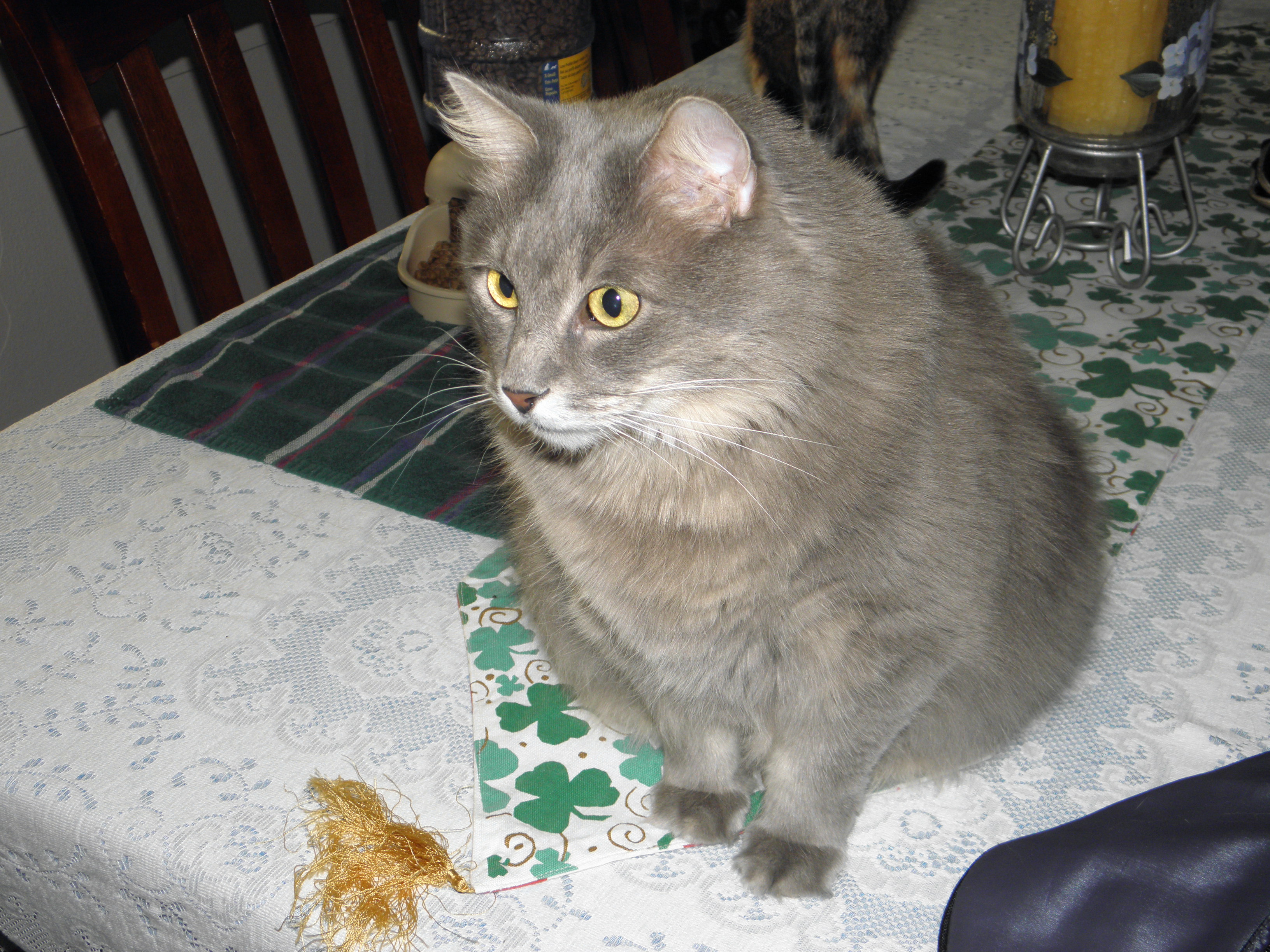
Yes, he’s gorgeous. He’s sweet and loving, too. He’s also hot as hell when he snuggles in your lap on an August evening. This is Ace. He alone is responsible for 20 percent of our summer air-conditioning expenditure.
The problem (or convenient excuse) is that we seem to have less time in these traditional vacation months than we do in the spring and winter, what with yard work, cookouts, concerts, etc. Or maybe it’s because of the energy-sucking humidity and the heat that seems to lie on you like a big, fat, long-haired cat (my wife and I have one, so we know). Bird watching is a lot more fun when it’s cooler and the air doesn’t feel like you’re the victim of a cosmic waterboarding.
We need to take a Saturday or Sunday and drive down to the Marais des Cygne Wildlife Refuge in Kansas or maybe a weekend to visit some of the refuges along the Mississippi River in Missouri. We could probably add most of the species we need to hit 200. We’re only 15 away, after all.
Will we do these things? Maybe in the fall.
Anyway, this is my annual post of shame, the one I write to admit how terrible a Big Year birder I am, lacking persistence, dedication, imagination, spontaneity, enthusiasm, creativity, moral fortitude, heat-resistance and talcum powder. This list of character absences leaves me with little except the ability to criticize myself. At least that’s something.
And yet – the summer is not over. I still have a month left before Labor Day, still time to throw the binoculars and scope in the car and see what’s happening beyond the backyard with its American Goldfinches, House Finches, Ruby-throated Hummingbirds, Blue Jays, Mourning Doves, Starlings, House Sparrows, American Robins, Black-capped Chickadees, Red-bellied Woodpeckers, Downy Woodpeckers, Northern Flickers (Yellow-shafted only), stray cats, raccoons, possums, 13-lined ground squirrels, golden-mantled ground squirrels, just plain ordinary tree-dwelling birdseed-eating squirrels and Lucy, our squirrel- possum- raccoon- cat- bird-chasing dog.
Around here, there’s no shortage of animal activity. In fact, it’s a little wildlife refuge all on its own. And it can be watched through windows with a nice flow of cool air keeping the sweat at bay.
But no. Must not give in to air-conditioned comfort. Must fight temptation to nap the hot afternoon away. Must plan outing to see new birds. Soon. Very soon.
If you’ve been to the Rocky Mountains, you know how gloriously blue the sky can be. Now imagine a bit of that azure clipped out and dropped onto a fencepost. You have a Mountain Bluebird. If there is a bird in the world that makes better use of a single color, I want to know about it. A Mountain Bluebird is a breathtaking as a brisk hike at 12,000 feet.
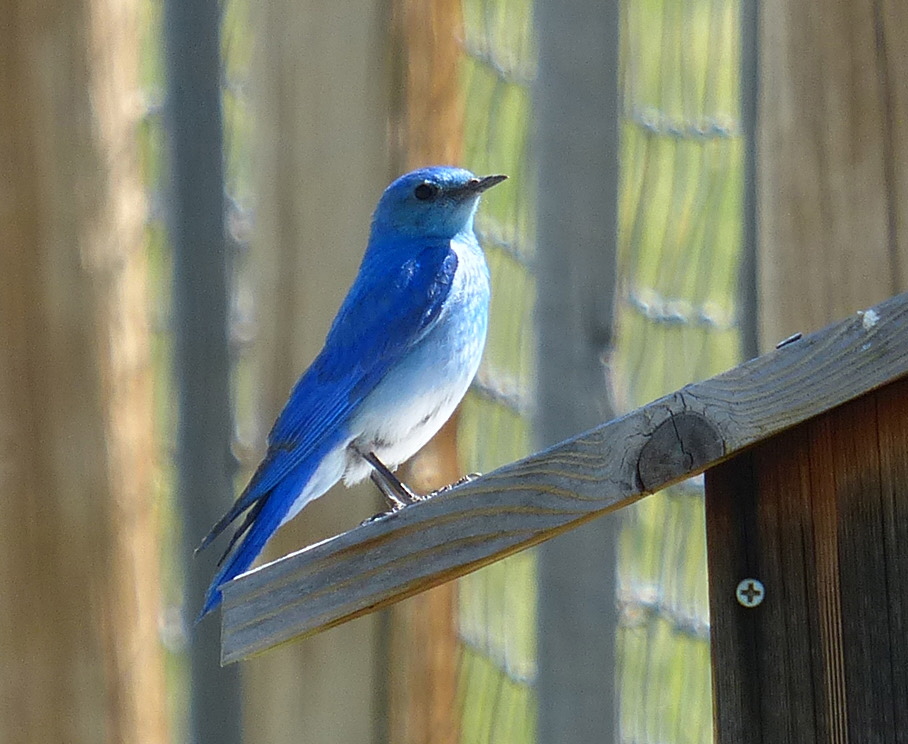
One of Terry’s Mountain Bluebirds perches atop its nesting box near Montrose, Colorado. Photo by Terry Ryan.
For many years now (I doubt he’d want me to say just how many), my brother Terry has been tending and observing the activity around a group of bluebird nesting boxes in a state park not far from his home in Montrose, Colorado. Needless to say, Terry is a birder and has been contributing species to our 2015 Big Year list regularly. He doesn’t seem to mind being responsible for all the birds in the western U.S. The rest of us live in the Midwest and East.
A few years ago, my wife Fran and I accompanied Terry and his wife Cheryl on a visit to the nesting boxes. We were treated to close-up viewing of Western and Mountain Bluebirds by the dozens as well as their nests and eggs. Terry had put together a display, complete with his own photos, providing a lot of good information about the birds and their behavior. It took up a prominent spot in the state park headquarters.
Terry had been caring for the birds and educating park visitors entirely as a volunteer. It was a proud moment seeing his dedication and recognizing Cheryl’s patience with him. They both deserve a lot of credit for helping bring back birds whose populations had been declining.
It’s also nice to be able to add Mountain and Western Bluebird to the Big Year list this year, along with all the other birds Terry and Cheryl have contributed. Without them, we wouldn’t yet have broken last year’s count of 179 species.
Official Big Year species count: 181
Brother Phil, who has been a major contributor of unusual and interesting birds to our Big Year list, spotted a Dickcissel the other day. According to the reference books, Dickcissels aren’t unusual within their range, nor are they rare, endangered or threatened, but we usually see only one or two a year around Kansas City. What makes these little birds interesting is their behavior and appearance.
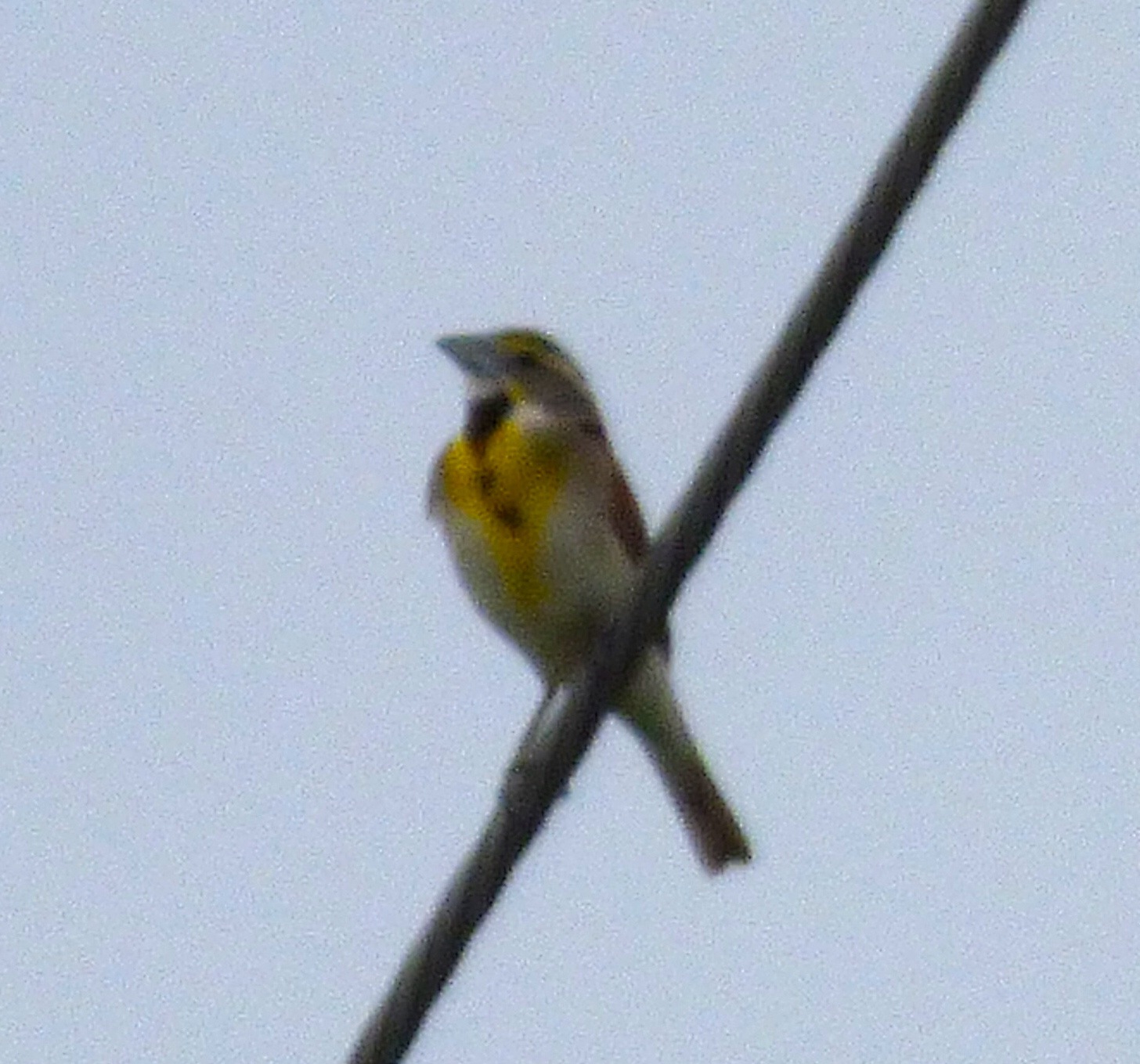
Phil apologizes for the quality of this shot, but it certainly shows the Meadowlark-like markings on a Dickcissel.
Dickcissels look like miniature Meadowlarks and are often mistaken for them. Meadowlarks are much larger and, of course, their song is quite different. In fact, Dickcissels are named for their song, which might account for the name’s weird sound, if not its odd spelling.
When they arrive at their nesting grounds, which cover just about the entire middle third of the country from Texas to the Canadian border as well as few more eastern states, Dickcissels spread out and establish their territories. But when they’re not breeding, they can form huge flocks. They’re true prairie birds, loving weeds, brush and tallgrass habitats where they feast on seeds and insects. In the winter, they retreat to southern climes, all the way into Central and South America.
In the Sibley Field Guide to Birds of Eastern North America, the Dickcissel shares its spread with the Western Spindalis and Bananaquit, some pretty rarified company as well as the Blue Grosbeak. But it isn’t closely related to any of them. It’s its own bird, so to speak.
The reason Dickcissels are sometimes mistaken for Meadowlarks is the coloration of the breeding adult male. Like the Meadowlark, it has a black bib on a yellow breast. At a glance, the resemblance might fool you, but a second look shows the truth. The Dickcissel is about the size of a House Sparrow. The Meadowlark is closer to European Starling size.
It’s probably clear from this post dedicated to a single species that we’re into the doldrums of summer after the birdstorm of spring when it comes to picking up Big Year list additions. But we’re staying with it and hope to do better with a few field trips in the coming months. You never know what feathered anomaly might lurk around the next bush.
The reports came in on the Cornell Laboratory of Ornithology Rare Bird Alert last week. Several people had spotted a Swainson’s Warbler at Hidden Valley Park in North Kansas City, about a 30 minute drive from our place. My brother Phil decided to go take a look but didn’t see or hear the bird. This first foray was a bust, but when he returned over the weekend, he found the quarry, at least by voice. Early Monday, he was able to get a photo good enough to clinch the identification.
Who cares?
Consider this: The Swainson’s Warbler is normally found in the southeastern U.S., its range barely extending into southern Missouri with rare instances in the central and eastern parts of the state. We’re in northwestern Missouri, making the Swainson’s Warbler a rarity, indeed. What’s more, we could have a nesting pair on our hands. Is this another instance of birds (and other animals, such a armadillos) moving north as the climate warms? Only time will tell.
Still don’t care? I can’t help you.
My wife Fran and I visited the park on late Sunday afternoon but had no luck. Turns out, we were in the wrong part. There’ s a nature preserves south of the developed park, and that’s where the warblers are. We figured this out as we drove away. A tiny sign told us so. But we were out of time. Our suspicions were confirmed by an email from Phil that evening explaining the situation. He apologized for being somewhat behind his time. We’ll find a way to forgive him.
No matter what else might be true, the Swainson’s Warbler is a great addition to our Big Year list. Now all we need are the common birds we’d expect to see in the summer, and we’ll quickly beat last year’s count.
Official Big Year species count: 177
I feel I should apologize for warbling on, but this has been a good year. We’ve seen 16 firmly identified warbler species and one we’re still fighting about. Is it a Canada Warbler or a first spring Magnolia Warbler? My brother Phil’s quite nice photo should be enough to give it away. Personally, I’m taking my stand with Canada, but we’re open to arguments from anybody.
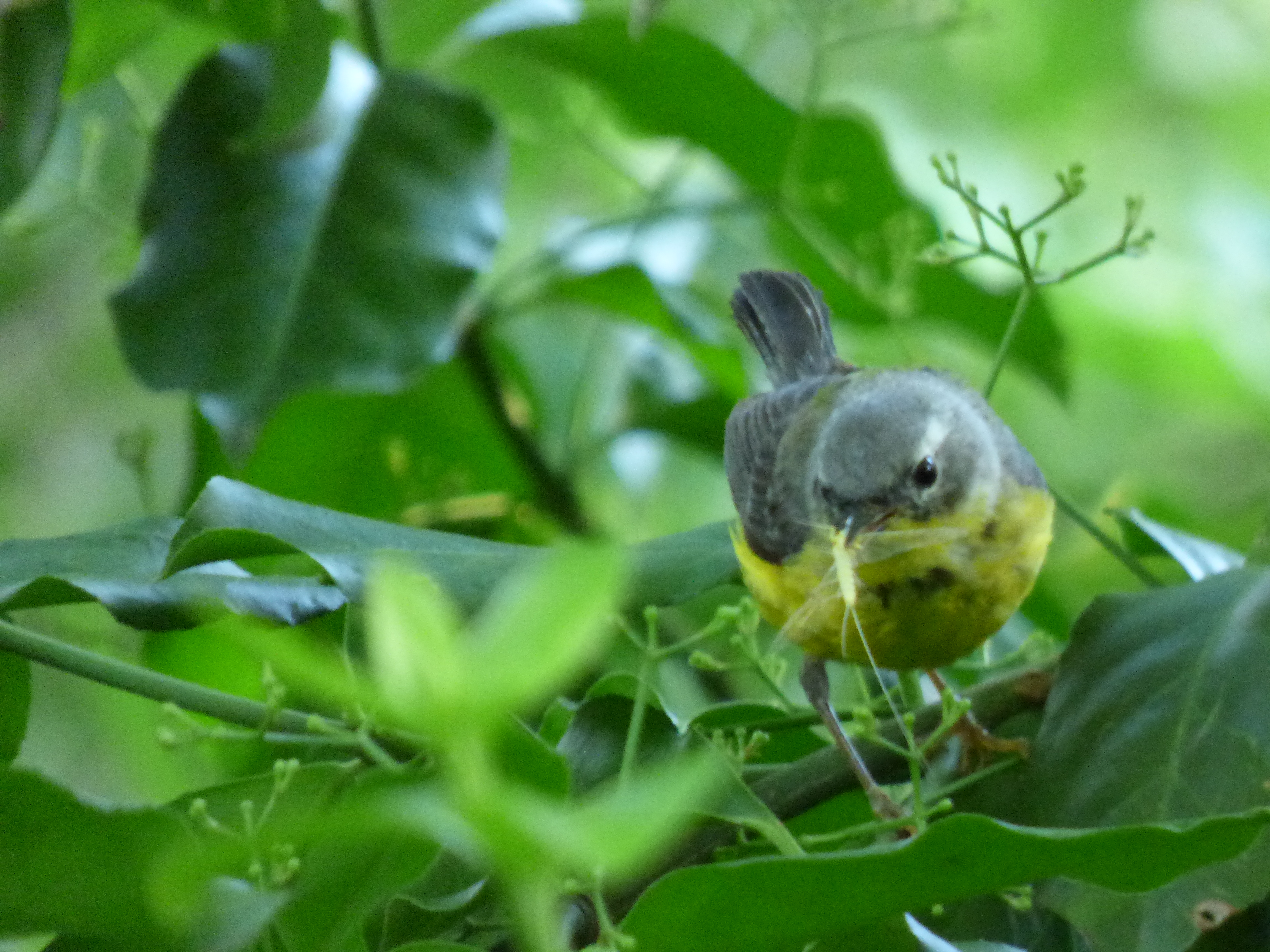
You decide. Is it a Canada Warbler or a first spring Magnolia Warbler? Let us know. Photograph by Phil Ryan.
Speaking of anybody, the strangest thing happened. I got a message the other day that I assumed was from Phil about sighting a Piratic Flycatcher. Apparently, one has been reported in The Kansas City Star, and the message sender claimed to see one in the company of a couple of House Wrens.
Now the Piratic Flycatcher, which gets its name and pirate reputation from its habit of taking over other species’ nests, shows up spottily in Florida, Texas and New Mexico – not Missouri and Kansas. But as we all know, birds have a way of surprising us. Nevertheless, I decided to let loose the canons of sarcasm and wrote back: “Was it wearing a little tri-cornered hat? Did it walk, hop or swashbuckle? Was its call a chirp, peep or ahoy, matey?”
Turns out, Phil didn’t send the message. I still don’t know who did, but whoever it was must think I’m a real jerk, which, perhaps, I am.
So, anyway, we’re approaching the end of the migration season for warblers around these parts. Seventeen warbler species isn’t bad at all, certainly the best I’ve ever seen. There were some notable absences, such as the Blue-winged we saw last year. That’s disappointing but not devastating.
It’s important to note that we’re within four species of beating last year’s count. We still have seven months to go and lots of common species to see. So let us sail on to glory or at least make a decent showing.
Official Big Year species count as of May 27: 176
 Bird Poop