Thanks in large part to my eagle-eyed brother Phil, things are looking up warbler-wise. And I use the term “looking up” with full knowledge of its double meaning. Phil, my wife Fran and I are all developing cases of warbler neck from staring into the treetops for long periods. The only plus to this activity, aside from spotting the flitting little chirps, is causing complete strangers to study the sky for UFOs.

This is John James Audubon’s take on the Great-crested Flycatcher. I could have used a photo of some kind of warbler but, frankly, I don’t want to give the hyperactive little twerps any more space.
So far this month, we’ve added these gems to the 2015 Big Year list: Blackpoll Warbler, American Redstart, Common Yellowthroat, Connecticut Warbler, Black-and-white Warbler, Golden-winged Warbler, Wilson’s Warbler, Ovenbird, Yellow Warbler, Nashville Warbler, Louisiana Waterthrush, Worm-eating Warbler and Kentucky Warbler. It has probably been the best year we’ve had for warblers here in Missouri and Kansas .
Phil and his wife Susan are headed for Door County, Wisconsin, this week, so we’re hoping for even more warblers to join the list. Door County is a hot spot. I’ve been there when the trees were dripping warblers, and it was this time of year.
Our outings this month have yielded some other good finds, so now we’re only 19 species away from last year’s total, which was 179. Included among the particularly exciting birds are Great-crested Flycatcher, Evening Grosbeak, Rose-breasted Grosbeak, Wilson’s Snipe and Brown Creeper.
Brother Phil says he’s becoming dangerously addicted to warbler hunting, and I understand his enthusiasm. Getting your feet soaked from wet grass on a chilly May morning when you should be snug in bed instead of being sucked dry by wood ticks and mosquitoes the size of your left butt cheek while trying to get a bead on a bird the size of a walnut that seems to have made avoiding your eyes its life’s purpose and whose song sounds like every other warbler on earth, making it impossible to identify without shooting it is really fun.
Can’t wait for next year.
In our part of the world – western Missouri and eastern Kansas – this is the time of the warblers. They begin arriving in early to mid-April. By mid-May, they’re pretty much gone, headed to their nesting grounds in more northern latitudes.
While it lasts, the show can be impressive. These small birds make up in arresting colors what they lack in size. When several species feed together in a single tree, flitting from branch to branch, the effect can be dazzling.
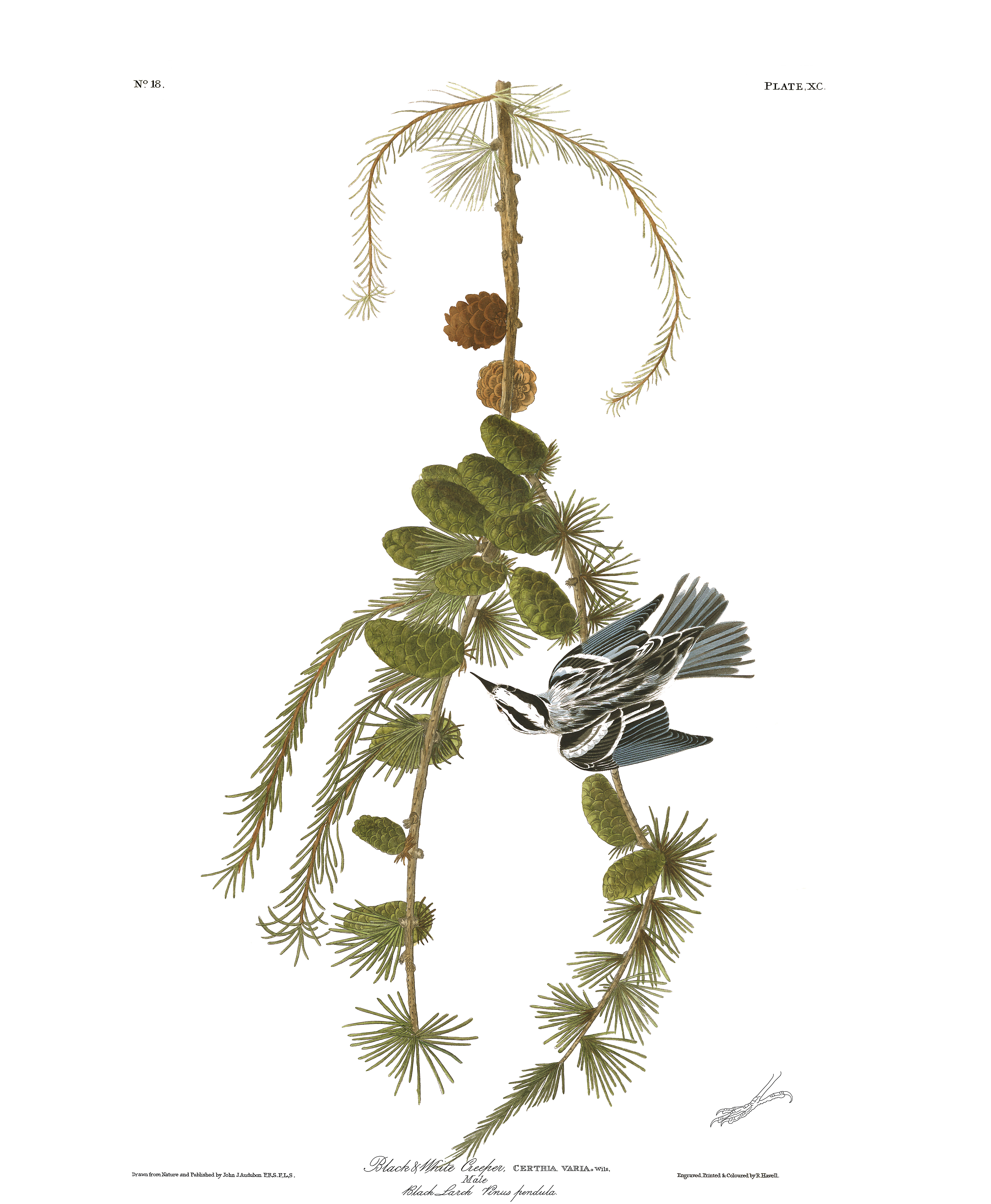
John James Audubon called it a Black-and-white Creeper. We know it as the Black-and-white Warbler. It might not have the bright colors of other warblers, but it’s striking in its own right.
On a single outing in early May, we’ve seen as many as eight or nine warbler species, including American Redstart, Common Yellow-throat, Yellow Warbler, Black-and-white Warbler, Yellow-throated Warbler, Tennessee Warbler, Nashville Warbler, Prothonotary Warbler, Kentucky Warbler, Wilson’s Warbler, Northern Waterthrush, Yellow-breasted Chat and others. A day like that keeps you coming out year after year.
Our 2015 big warbler day will probably be during the second weekend in May. We’ll most likely find our way to the James A. Reed Memorial Wildlife Area, a spot I’ve mentioned several times. We’ve had very good luck there, even picking up Blue-winged Warblers last May.
We need all the warblers and other birds we can mine from the avian riches of spring to build our Big Year list. My wife Fran and I will be at the Lake of the Ozarks over this coming weekend and hope to pick up a few new species. I’ve been researching the best warbler areas near the lake, and it looks promising.
According to the Cornell Laboratory of Ornithology’s daily record of rare bird alerts for Missouri and Kansas, there are also quite a few shorebirds and waders passing through. Maybe we’ll get lucky on that score, too. Then again, it could turn out to be a hope-dashing, confidence-crushing, bleak wasteland of a weekend when every bird seems to be making a conscious effort to avoid us.
You never know.
It was a pretty good day of birding, all told. Brother Phil and I started before sunrise on April 11 with a drive to the Marais des Cygne Wildlife Area about 50 miles south of Kansas City on the Kansas side of the state line.

A Bonaparte’s Gull found its way to a lake near Montrose, Colorado, and added a new species to our Big Year list. Photo courtesy of Terry Ryan.
We’d learned from the experts that several warbler species migrate through this part of the world in early to mid-April. Although we did pick up 50 new birds, including 12 that were new to our Big Year list, we saw only a few Yellow-rumped Warblers. Apparently, the others didn’t attend the lecture.
Yellow-rumped Warblers hang out in this area all year. Seeing one is about as exciting as spotting a House Sparrow, except the warblers are prettier and springier because of their yellow-rumptedness.
Speaking of sparrows (Yes, I know House Sparrows aren’t Sparrows. They’re finches. Just bear with me.), we did add three – Lark, Harris’ and Vesper – all new to the list. We also counted a Scissor-tailed Flycatcher, Eastern Wood Pewee, Franklin’s Gull, Red-headed Woodpecker, Barn Swallow, Blue-gray Gnatcatcher, Brown-headed Cowbird, Brown Thrasher and Tree Swallow.
Meanwhile at a lake near Montrose, Colorado, brother Terry was watching Western and Bonaparte’s Gulls and Mute Swans. So the total of new species for the weekend was 15. Kind of exciting for birders who are used to living with disappointment.
We’re not giving up on the warblers, of course. In early May, we’ll head for the James A. Reed Memorial Wildlife Area a few miles east of Kansas City. We’ll rise in the dark, pack up our binoculars, scopes and field guides, fill large travel mugs with coffee (leading to frantic searches for scarce toilets later) and sally forth on our quest for the Holy Quail. Ticks and mosquitoes be damned.
In “The Wasteland,”T. S. Eliot dubs April the “cruellest month.” His judgment has nothing to do with April Fool’s Day pranks. It does have a lot to do with the weather.
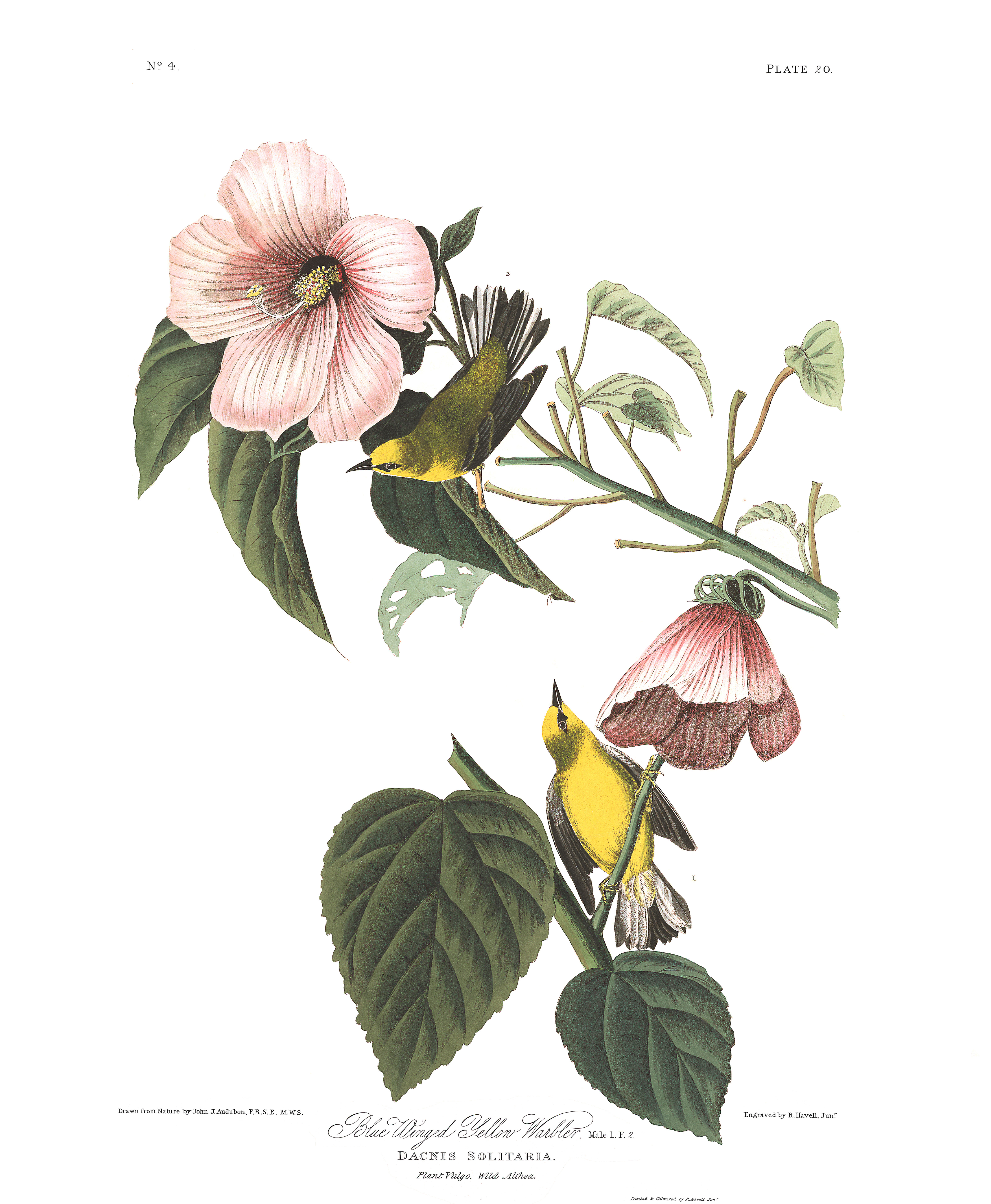
John James Audubon called it the Blue-winged Yellow Warbler. Brevity is the way today. After all, it’s the Twitter Age.
My problem with April has to do with birds (of course), mold and pollen. On the one hand, I look forward with almost ecstatic anticipation to picking up a bunch of migrating species, especially warblers. On the other hand, I dread the onset of miserable itchy eyes and persistent sneezing. Eliot is right. April has its ups and downs.
That said, brother Phil, wife Fran and I will be looking for the earlier warblers come April 11 at the Marais de Cygnes National Wildlife Refuge about 50 miles south of Kansas City on the Kansas side. (Marais de Cygne, by the way, means Swan Marsh. I’ve never seen a swan there.) We’ll probably be out several more times before mid-May, catching the migration waves, you might say.
Last year in May, we saw Blue-winged Warblers at the James A. Reed Memorial Wildlife Area near Lee’s Summit, Missouri. They were a life lister for me – also really striking birds. At first I thought the colors I was seeing must be a trick of the early light. It won’t be easy to duplicate that experience this year, so we’ll go for number of species rather than first-time species.
In years past on these spring outings, we’ve seen Common Yellowthroat, Yellow-rumped, Yellow, Tennessee, Black-and-white, Prothonotary, Kentucky and Wilson’s warblers as well as Northern Waterthrushes and Redstarts and probably a few others I’ve forgotten about. Doesn’t seem like very many species, but we’ve always gone just once in May. This time we’ll do it at least twice, three times if we’re lucky.
In keeping with its reputation, April will, of course, be cruel. We’ll probably get rain and cold at least once, ticks and mosquitoes later in the month, slippery mud and other discouragements. However, we will endure, in spite of eyes that are sources of torture despite medication.
No endeavor worth pursuing, no matter how idiotic, is ever without challenges. This is what I will tell myself.
Official Big Year species count as of April 3: 106
Fifteen or so years ago, when my wife, Fran, and I started making what is now an annual pilgrimage to Kearney, Nebraska, it was easy to find a hotel room for the weekend. Those days are long gone. It seems another annual pilgrimage, the one we go to observe, has captured more of the public imagination.
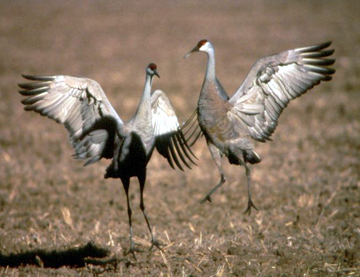
Sandhill Cranes dance as part of their mating ritual. They also mate for life. Not that the two are related, but maybe we could learn something anyway. People should dance more. It could be good for their relationships.
Each year, between late February and early April, about half a million Sandhill Cranes pass through an hourglass opening along the Platte River, roughly between Kearney and Grand Island – about 50 miles of farm fields and pasture. It’s a place where, in March, the wind can blow hard and cold, though the cranes don’t seem to care. They stand around like people at a cocktail party, dipping occasionally to pick up an hors d’oeuvre and chatting, except when they leap into the air and dance to indicate their willingness to carry on the conversation in a bit more intimate manner. Spring is coming in, after all, no matter what the weather might say.
This year, we made our hotel reservation months ahead and almost missed the boat. We finally found a room at the Wyndham Microtel which, fortunately, turned out to be more than adequate and priced right. There were plenty of other birders staying there. We could recognize them by the lump of flesh at the base of the skull that makes even the skinniest of them look a little like a Sumo wrestler. It’s caused by staring up into treetops for hours on end trying to identify warblers that refuse to sit still long enough get a bead on. But that’s another story.
The cranes were, as always, an inspiration. If you haven’t seen them fill the sky as they return at sunset to their roosts on the river’s sandbars, you owe it to your appreciation of life and beauty to do it. They’re large birds that make a croaking sound as they fly, feed and roost. Their long legs stretch out behind them, and they form ragged Vs as they pass in silhouette against a sky still lit in shades of orange and crimson. Fran and I always leave their great gathering revitalized and renewed after a long winter.
The cranes aren’t the only draw that gets us to the Platte each year. This time, we picked up a few new species for the Big Year list: Lesser Scaup, Western Meadowlark, Gadwall, Killdeer, Trumpeter Swan and American Wigeon. That got us to 99 species. Brother Terry in Montrose, Colorado, sent in a few of his early spring sightings, so we ended up breaking the 100 species mark at exactly the same time we did last year. We need to up our pace.
Official Big Year species count as of March 27: 105
I grew up in Emporia, Kansas, in the southeastern part of the state. At the time (which I won’t specify), Emporia boasted a population of about 20,000 when the two colleges in town weren’t in session.
Every third or fourth December we’d spot a Snowy Owl or two forced south, presumably, by the promise of food that had grown scarce in the birds’ native northern regions.

If nothing else about a Snowy Owl grabs your attention and imagination, try gazing into the yellow eyes for while. Photo by Petr Kratochvil.
I remember two owls in particular. One was on top of a power pole at the John Redmond Reservoir east of town, the other on a neighbor’s TV aerial (remember those?). In both cases, the birds were lit by the setting sun, their white feathers glowing rose in the dying winter light.
The images are burned into my brain like no others from childhood, except maybe for the time I had to stand in front of my third-grade class and confess that the story I’d told about my brother Terry, who was then in high school, killing and skinning a bear had been, well, exaggerated. I hadn’t considered that the teacher would verify my account with my brother Scott, who was in eighth grade at my primary school.
Last year, while we were attempting our first Big Year, my wife Fran, my other brother Phil and I followed every lead so we could add a Snowy Owl to the list. We failed. This year, there have been reports of sightings about 150 miles west of our base in Kansas City, at the Cheyenne Bottoms Wildlife Area near Great Bend, Kansas, but none nearby.
All this preambulation leads up to a basic truth of birding: It’s always the person sitting right beside you, who just started watching birds a couple of years ago and not, like you, with more than half a century of freezing in gale winds and broiling under desert suns who will see the feathered ?!#%&$@ you’ve been questing for – and you will miss it entirely.
So it was last Sunday that, when we were driving through a prosperous part of town, Fran spotted it – a big white bird that could only be a Snowy Owl, flying north. I didn’t see it. So I grilled her on what it looked like and tried my best to come up with alternatives, which, truth be told, were much more unlikely (think Northern Goshawk).
Nothing worked. It was a Snowy Owl. Fine. It’s on the list.
Since my last post, we’ve added Lesser Goldfinch and Black-billed Magpie, thanks to brother Terry in Montrose, Colorado. Here in K.C., the Common Grackle summer population has begun reestablishing itself, so that makes four new birds.
Official Big Year species count as of March 6: 94.
Many years ago, I was lucky enough to spend about nine months in Australia as an exchange student. The dad in one of the families I stayed with was an avid bird watcher, and I’d go on day trips with him – each of which added some new species to the life list I’d begun to build. It was an exciting time, even though I was too young and stupid to fully appreciate all the opportunities that time spent in another country was handing me every day.
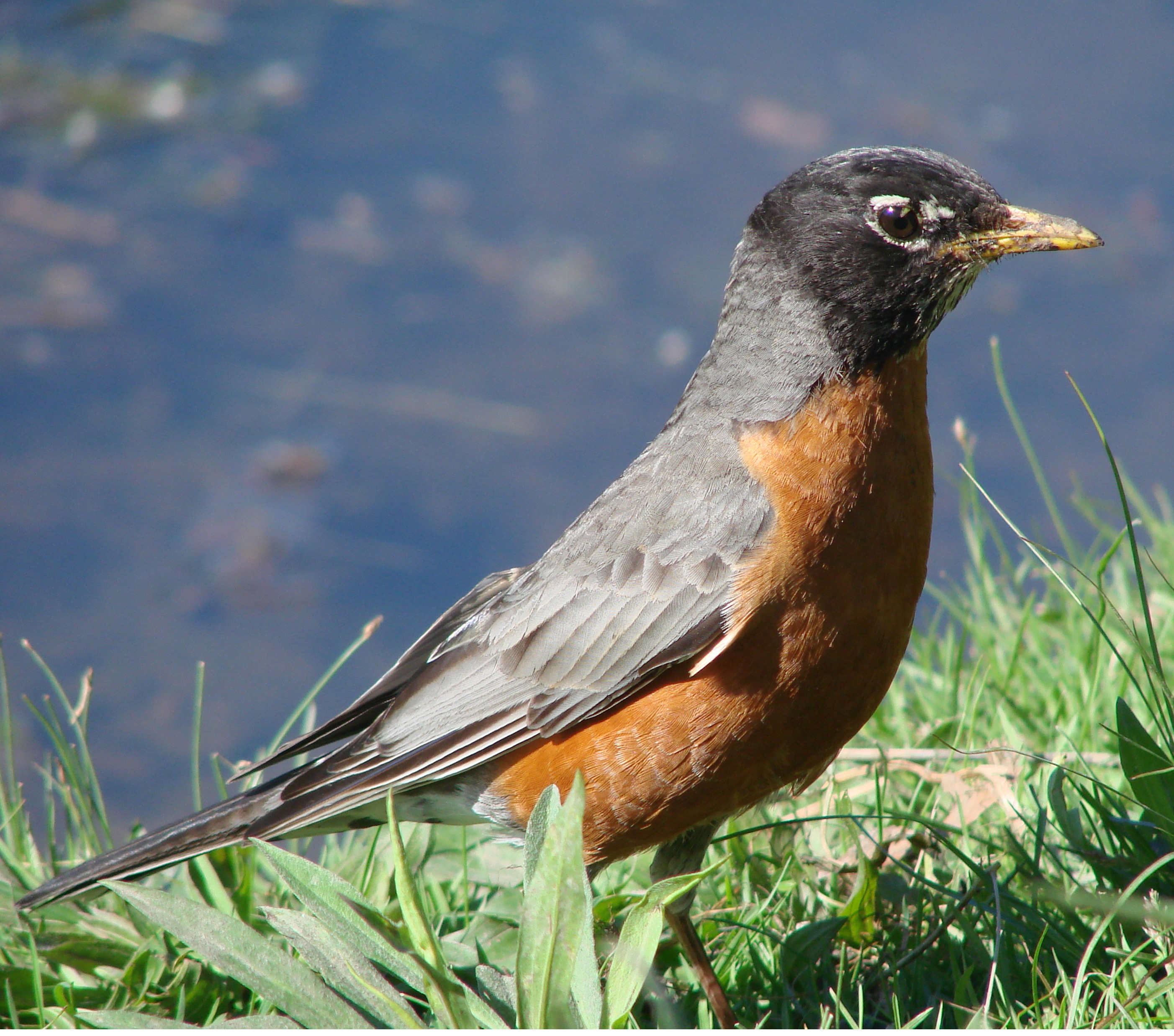
Turdus migratorius. Do yourself a favor and just call it a Robin – American Robin if you want to sound more knowledgable.
My failings as a callow youth aside, one drawback to our frequent birding excursions was the reaction of passersby, especially those in cars. We put up with quite a few hoots and hollers questioning our sanity, sexuality, maturity and intelligence. It was all somewhat distracting.
Bird watching seems to be a little more acceptable these days, at least among motorized motormouths. It is, after all, supposedly the second most popular pastime in the United States, behind gardening.
However, if you read the list accumulated during your most recent outing to someone unfamiliar with the joys of birding, you begin to see why a certain prejudice against the pursuit still exists. You’ll also understand why you should learn all the scientific names of the birds you see and restrict your use of the common names when communicating with the uninitiated.
You tell me. Which sounds more worthy of serious consideration: Tufted Titmouse or Baeolophus bicolor? How about Yellow-bellied Sapsucker or Sphyrapicus varius? Bananaquit or Coereba flaveola? Pygmy Nuthatch or Sitta pygmaea? American Robin or Turdus migratorius?
Okay, that last one is just the exception that proves the rule.
The field of battle in the war for bird watchers’ dignity is littered with the bodies of amateur ornithologists like the one who, filled with the excitement of achieving a longtime goal, breathlessly told a non-birder friend about finally, after years of fruitless searching in the sun-dappled waters off the southern coast of Florida, raised his binoculars to his eyes and focused in on a Brown Booby.
What a difference it would have made had this naive birder said, simply, “At last, I saw a Sula leucogaster.”
Official Big Year species count as of February 27: 90.
Here’s the thing. Accipiters – Cooper’s hawks, sharp-shinned hawks and northern goshawks – annoy me. The young ones look pretty much alike, except for size, which isn’t a great identifier unless they’re sitting next to each other. Cooper’s hawks and sharp-shinned hawks look even more the same as adults.
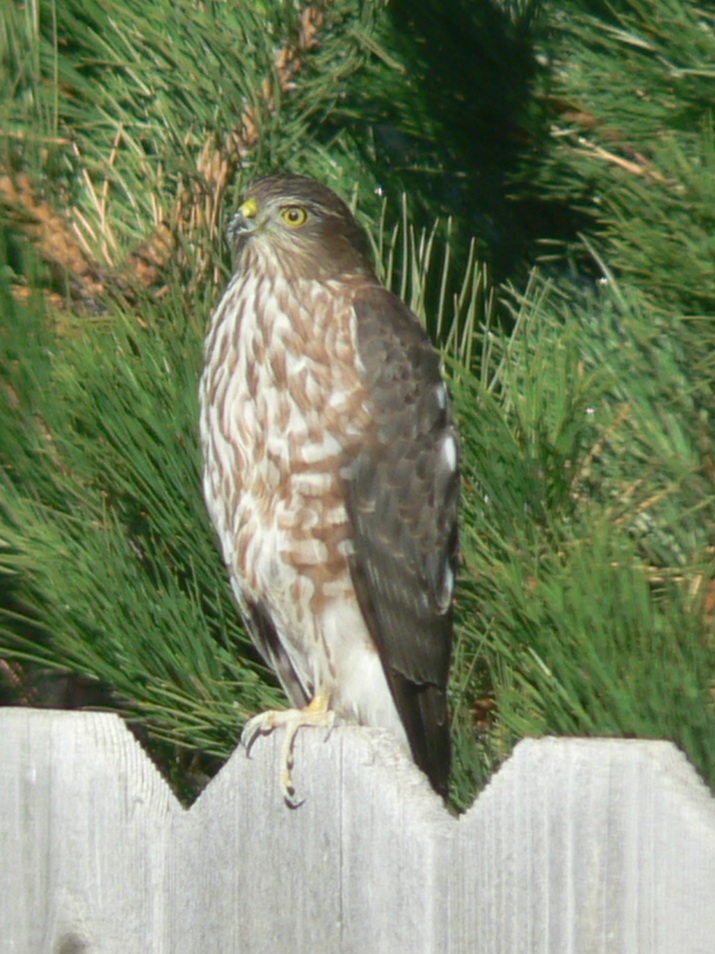
How we mistook this Northern Goshawk for a Cooper’s Hawk is an embarrassing mystery. It’s a Northern Goshawk, right? Tell me it is. Please. Photo by Terence Ryan.
These similarities wouldn’t be an issue if the birds would just take up residence in different parts of the country. Goshawks could live, say, in 21 of the states west of the Mississippi, Cooper’s hawks in the 28 states east of the Mississippi and sharp-shinned hawks in Kansas.
Sharp-shinned hawks are the smallest of the three species, so they’d leave more room for the flood of new businesses moving into the state since Gov. Sam Brownback’s tax cuts took effect.
I bring all this up because, as I was trying to find a subject for this blog I found a photo my brother Terry snapped of a brown hawk with a streaked breast. When I first saw it sometime last year, I thought, “Cooper’s Hawk,” and put it in a file.
I found it this morning and decided to make sure it was a Cooper’s Hawk rather than a Sharp-shinned Hawk. Wrong on both counts.
My trusty Sibley Field Guide to Birds of Eastern North America cleared things up. The bird I was looking at in the photo had a distinctive yellow mark over the beak and a white “eyebrow.”
Juvenile Northern Goshawk. And it never made it onto our 2014 Big Year list.
Stupid, stupid, stupid accipiters. Blind, blind, blind birders. Bummer.
Of course, I added Northern Goshawk to the 2014 list anyway. I might be a blind idiot but I’m not a blind fool. You don’t see these critters every day, so they really dress up a list. We see it. We count it. Even if it takes us a decade to figure out what it is.
Official Big Year species count as of February 13: 84. Brother Phil spotted a Hooded Merganser since my last post.
I’ve noticed over the past couple of decades that birds I used to see almost exclusively outside the city and suburbs have moved in. They’ve taken up residence even where the most “natural” thing on the landscape is a streetside Bradford Pear with carbon monoxide poisoning.
These new neighbors include red-tailed hawks, peregrine falcons, Cooper’s hawks, sharp-shinned hawks, barred owls, great horned owls . . . hmmm. There seems to be a pattern here. Many of them, apparently, are predators. Maybe there’s something about food involved?
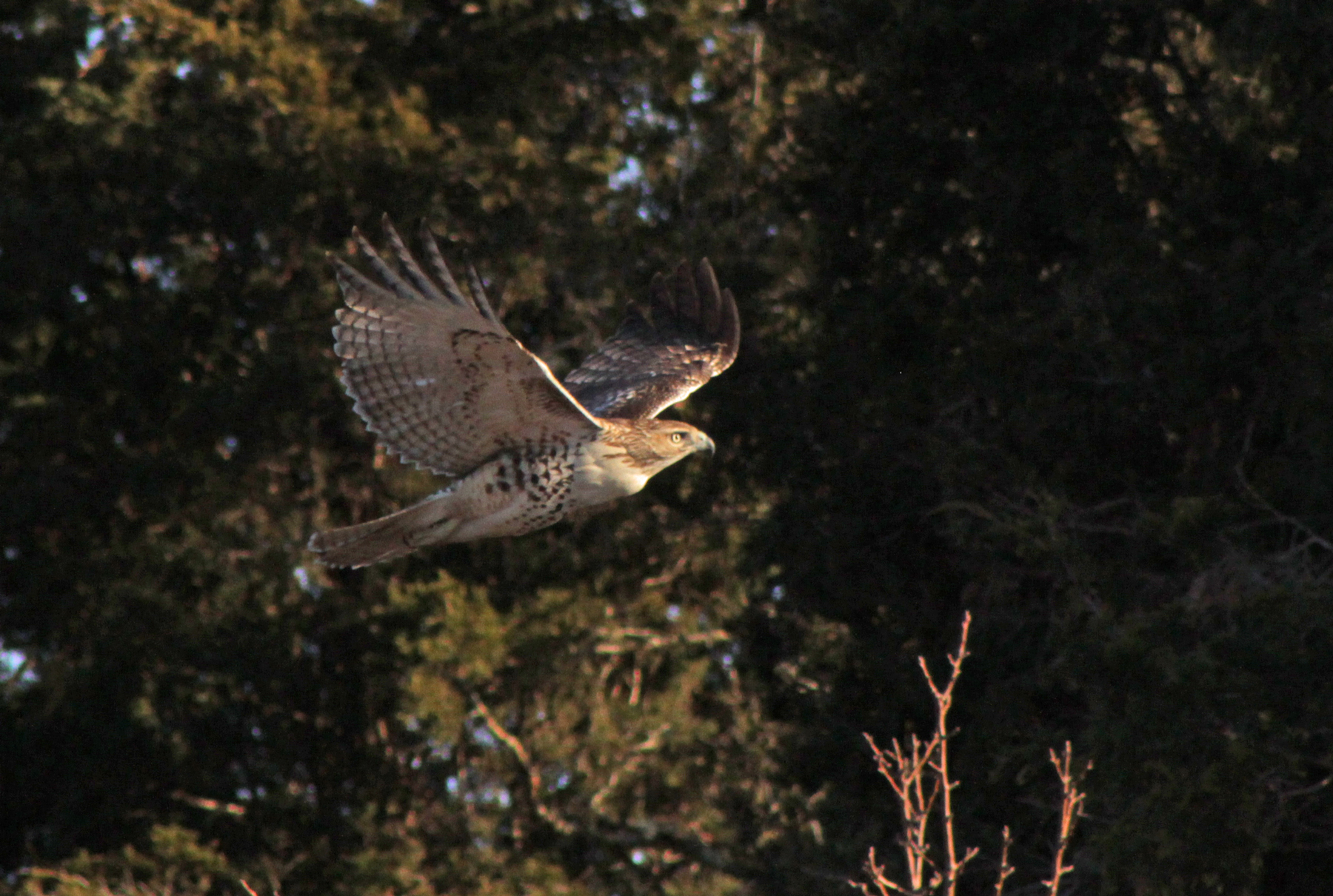
Red-tailed hawks have nested on the roof of a three-story building in a shopping area near our home. The family could be noisy, but nobody tried to get the birds evicted. Photo by Colin Andrews.
So I did a little research. That is I asked Google, and Google didn’t come up with much in a couple of minutes, so I quit looking and made myself a cup of coffee.
Anyway, there doesn’t seem to be much research on the subject. I know the Peregrine falcons have moved in mostly because of conservation efforts. They’re easily fooled into thinking tall buildings are high cliffs and so pretty good places to build a nest. They’ve also been provided with subsidized cold-water fly-ups in the form of nesting boxes. And then there’s the abundance of fat pigeons (rock doves or rock pigeons to those in the know) to feed on.
But the Red-tailed, Cooper’s and Sharp-shinned hawks and the owls are another matter. They seem to have made the decision all on their own.
My hypothesis is that it’s finally about food. I mean, look at it. We have more foxes in my neighborhood every year, along with more feral and wandering house cats. Foxes like cats, and not in a way cats appreciate. Possums regularly mosey up on our front porch, ring the doorbell and ask us if we’ve accepted Jesus as our personal savior. And don’t get me started on the squirrels. They’re forming street gangs and threatening the dog. So there’s a regular smorgasbord around here for hungry animals and birds at the top of the food chain.
We’ve seen all the aforementioned hawks in town this year, although the owls have avoided us. We’ve also spotted bald eagles sailing over I-70 where it passes through Kansas City, Kansas. When I was a kid, that kind of sighting would have been a sign of the coming apocalypse.
Actually, it’s great seeing all these birds in town. We don’t have to drive as far to find them, so we save on gas. The only thing that worries me is that the turkey vultures are getting thicker than flies over the city, too. Maybe we should give more thought to the apocalypse notion.
Official Big Year species count as of February 13: 83.
Of course, no more than three days after I published my post about the disappearing American goldfinches and how old niger/nyger/thistle seed might be the deterrent, a flock of around five showed up and feasted on that outdated seed for a couple of days. Maybe they were just too hungry to care in the middle of winter.
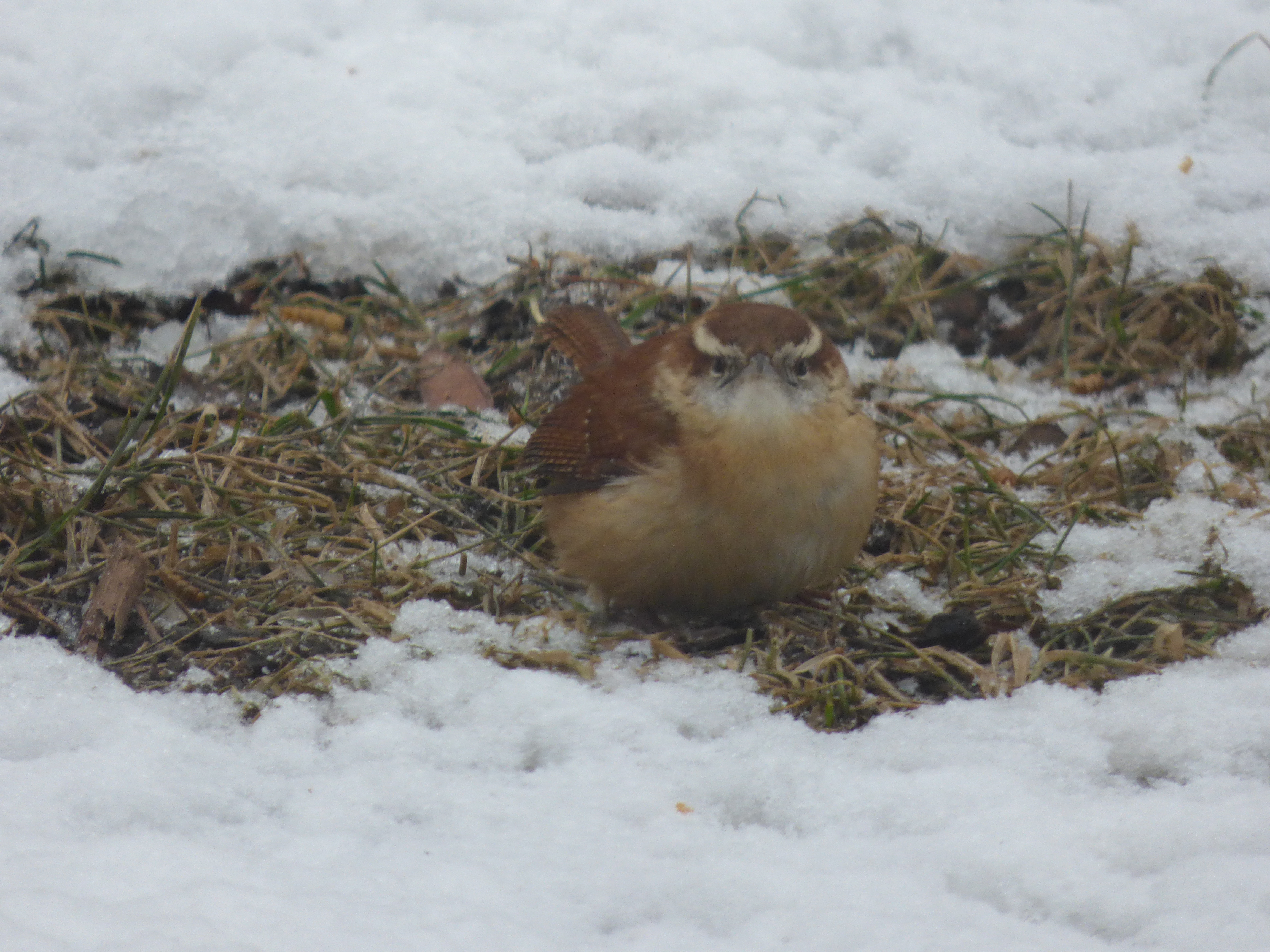
This Carolina Wren isn’t as irrelevant to the current post as an earlier photo showing my dog, but it’s still a bit out there. My brother was trying his new camera when he snapped this picture. Nobody’s sure what the wren was so mad about. Photo by Phil Ryan.
The incident reminded me of a story my mother used to tell about David Parmelee, the renowned ornithologist who taught for a time at the college in my hometown. I don’t remember which species he was talking about, but he told his students, one of whom was my mother, that they would never see a particular kind of bird perched on a fence wire.
You know the rest. The next time he took those students on a field trip, there was that bird, sitting happily on a fence wire. The lesson: Never make categorical statements predicting the behavior of birds (or anything else, except maybe gravity). They can hear you.
But on to the Big Year. My wife Fran and I took a drive to Smithville Lake north of Kansas City because there were unconfirmed sightings of Glaucous and California gulls as well as a female Long-tailed Duck. We didn’t see any of them, but we did pick up a Common Goldeneye, Common Merganser and Chipping Sparrow.
It was a rainy, cold and miserable day, although not as bone-chilling as it has been. The weather around here can change faster than Katy Perry can switch ridiculous-looking costumes during the Superbowl halftime show. (Yes, we watched most of that debacle. What was the Seattle offensive coordinator thinking? A one-yard pass? At the goal line? With downs left over? Good grief.)
Anyway, one day it’s zero here in western Missouri and eastern Kansas and the next it’s in the 50s. Makes the relative stability of southern Florida weather pretty attractive, even if it weren’t for the great birding down there.
I bring up Florida because after our trip to that state in early January, Fran has been thinking how nice it would be to live there. I’m not so sure. But that’s okay. We have a few years to mull it over. In the meantime, we’ll ride the midwest weather roller coaster and keep doing our version of the Big Year until we get one right.
Official Big Year species count as of February 6: 75.
 Bird Poop