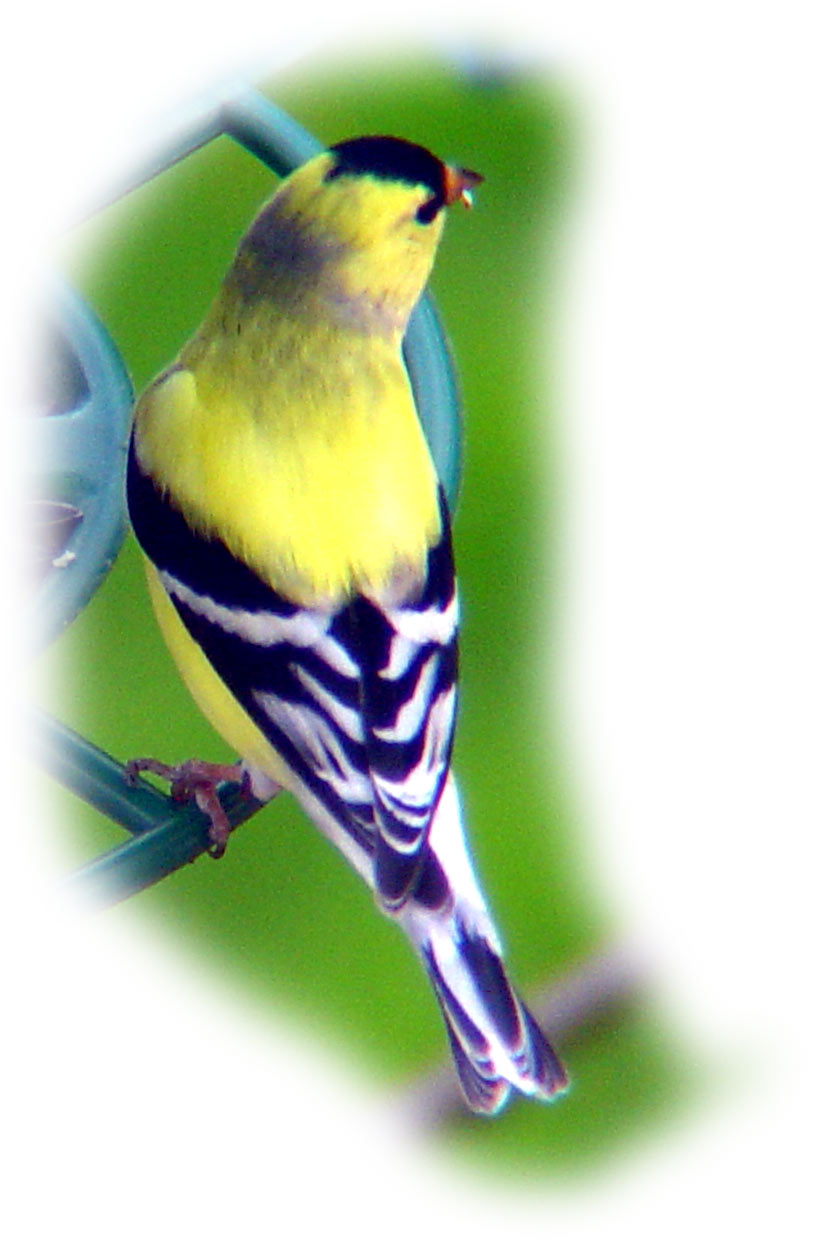
This American Goldfinch is, of course, in its summer plumage. It makes for a prettier picture, although I think goldfinches look rather elegant in the winter, too. Photo by Colin Andrews.
Here it is the end of January and not one American Goldfinch has shown its wintry semi-drabness at our backyard thistle/nyger/niger seed feeders.
(Aside: What is with this naming problem? Let’s choose a moniker for these little black seeds and be done with it.
I have a theory about the problem, and I hope no one is offended by it. Remember back when some politician used the term “niggardly,” which means “stingy”? It’s based on a Scandinavian word, but some people thought it was racist, even though the spelling says otherwise. I think perhaps the same issue has raised its ugly head with “niger” although, again, the spelling is off. So somebody thought, “Hey, let’s use a ‘y’ instead of an “i.” That’ll fix it.” But it didn’t fix it, so “nyger” then became the totally innocuous “thistle.” Sorry. I’m an old English major. These things actually interest me.)
Anyway, back to the Goldfinches. I’ve done some research, and I think it’s all my fault they aren’t coming in. I’m using old seed. American Goldfinches are apparently a bit persnickety about their seed. They refuse it if it’s more than six months old (try finding the “best if used by” labeling).
Best advice from the Web: buy your seed from a store that specializes in wild birds. Avoid the supermarket and hardware store. They sell cheap, but so what? If the birds don’t come, what’s the point? You’re still wasting your money.
I bring all this up by way of saying we finally added American Goldfinch to the Big Year list this past week, along with an Eastern Bluebird spotted in a large park in the area. We found the Goldfinch at a local nature center, happily feasting on what I can only assume to have been fresh ninythistle.
We’re still looking for a lot of the common species, such as the White-breasted Nuthatch, so we need to spend a few Saturdays and Sundays in the field. Would that we could take a year off from work for this noble pursuit, but then we’d starve and have to file for bankruptcy. I want to be like Steve Martin in The Big Year (admit it: you saw it, too), using my mountain villa as headquarters as I venture out into the wild in search of my 700th species, taking time only to dine in the finest restaurants and refuse to accept another few million dollars in earnings.
Official Big Year species count as of 30 January: 72.
If you don’t subscribe to the Cornell Lab of Ornithology’s eBird Rare Bird Alerts, you’re missing a great digital birding resource. It’s free, and you can get the service for every state and even other countries. It gives you all the information you need to locate rare birds in the area, with daily updates.
I bring eBird up because it came in handy lately. My brother Phil used it to pick up a Thayer’s Gull and Lesser Black-backed Gull on the lake at a nearby Kansas park. The sightings were some compensation for several trips to the same park in search of a Townsend’s Solitaire. That bird didn’t cooperate.
Although they’re becoming more widespread, the Thayer’s Gull and Lesser Black-backed Gull are still unusual in our part of the world and, as Phil put it, still as difficult as any other winter gull to identify with certainty. It’s good to have more than one reference to look at when ID’s are iffy. Phil used three or four.
Don’t like to drag printed field guides along on your birding walks? Another excellent resource is an app called iBird. I have iBird Ultimate on my phone and used it the other day to identify a Ruby-crowned Kinglet while I was walking our dog Lucy.
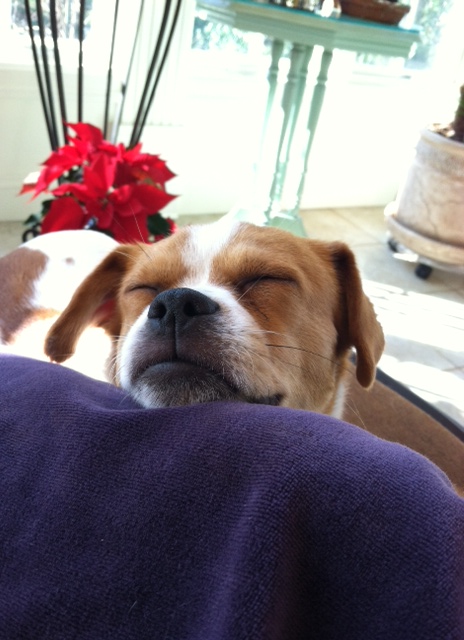
Yes, this blog is supposed to be about birds and birding. But, come on. Is Lucy not an adorable animal?
The app gives you not only illustrations and photos but also species’ ecology, identification points, range and other data. For example, did you know that a group of Ruby-crowned Kinglets is called a castle, court, princedom or dynasty?
Now, about the avian drunks I referred to in the headline. This time of year, trees sometimes still have fruit dangling from their limbs. If it has hung around long enough to ferment, birds seem to find it particularly attractive and belly up to the bar for a bender.
Robins are famous for this misbehavior, but I think Cedar Waxwings indulge, too. It certainly looked that way the day Lucy and I spotted the Ruby-crowned Kinglet.
A flock of about 10 waxwings occupied a medium-sized crabapple tree still dense with fruit. The small “apples” were soft and seemed rotten, but they were more likely soft and sodden, as were the waxwings. I can now say with authority that birds can fly with a stagger. Still, even waxwing sots count as a new species for 2015.
Official Big Year species count as of 23 January: 69.
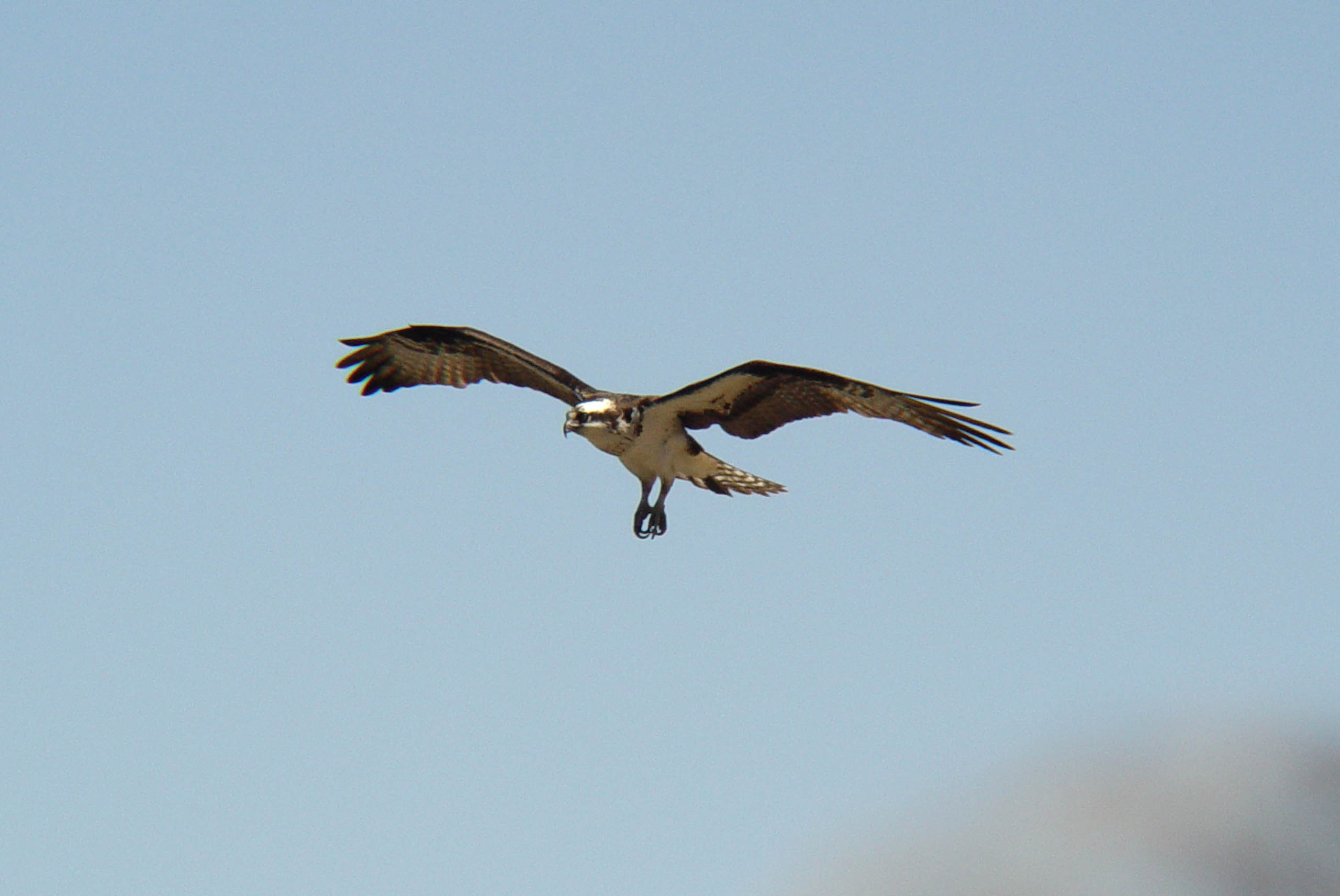
Ospreys are quite common in southern Florida. It’s good to see so many because use of DDT was a serious threat to them not long ago. Photo by Colin Andrews.
There’s no sugarcoating it. Last year was a bust.
It’s not that my wife Fran, my brother Phil and another brother, Terry, didn’t try to see as many bird species as we could. It’s that I did such a lousy job of recording our progress with this blog. I can use the excuse that my workload (the money-earning kind) got really heavy, and it would be true. But I could have done a much better job despite the long hours and weekends spent writing for clients.
Anyway, enough of the blogging flogging. I’m ready to get going again.
In 2014, we logged 179 species. Certainly not a stellar showing, but there you go. By this time last year, we’d seen 42 species. This year, we’d recorded 62 by January 15, thanks in large part to a trip Fran and I took to Florida, January 1-7. There were some life-list additions made during our travels, including a Northern Parula, Blue-headed Vireo and Snail Kite. We also picked up several of the usual suspects: Roseate Spoonbill, Osprey, Tri-colored Heron, Snowy Egret, Cattle Egret, Magnificent Frigatebird and others.
Warning: digression. Florida is really crowded. Traffic is a mess, and people drive like they’re all inebriated and suicidal. It’s hard to get out of town. It’s also sweaty. Despite all that, it is a birder’s paradise.
There are some great places to stay and to eat, too. We spent most of the time in Key Largo, with a day set aside to visit Key West, so we could say we’d been to the southernmost point in the U.S. and visit Ernest Hemingway’s house, and another day (obviously far to little time) for Everglades National Park.
In Key Largo, we stayed at the Marina del Mar Resort. It sits on a canal well off the Overseas Highway, the main and very busy drag, and is roomy and clean. The only problem for us was noise, and that pretty much went away after the final weekend of the holiday season when the kids went back to school. We’d recommend it, especially after the holidays, when the rates drop by about $100 a night.
Another strong recommendation goes for Doc’s Diner, almost directly across the Overseas Highway from Marina del Mar. It’s called “A Local Place,” and it has the hallmarks of one, including a grammatically challenged history of the joint printed on the menu. But, ah, the hash browns. Never have I had shredded potatoes so fluffy and delicious. Fran is still talking about her breakfast burrito as well. Fortunately, it’s not talking back to her.
But to return to the birds. In future posts, I’ll go into more detail about the most exciting (at least, for me) additions to the 2015 Big Year list, such as the Northern Parula, Blue-headed Vireo and Snail Kite . In the meantime, wish me luck at being a better correspondent.
I’ve promised myself one post a week for the rest of the year. Hold me to it.
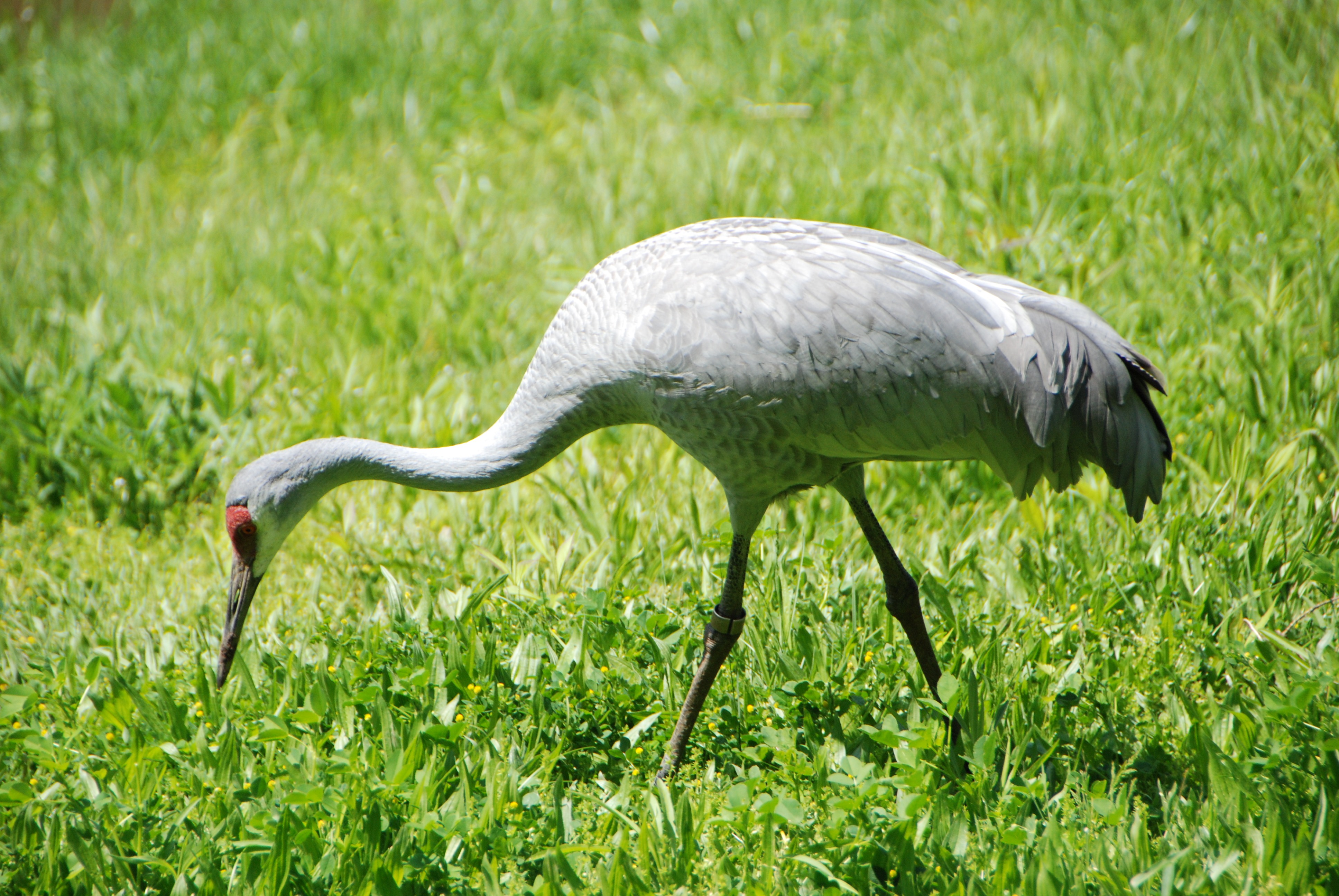
It’s the wrong season, and seeing one isn’t like seeing 500,000, but here’s a Sandhill Crane. They are magnificent birds, both on the ground and in flight.
(In which are recorded the adventures and misadventures of Christopher, his wife Fran, brother Phil and sister-in-law Susan as they pursue a birding Big Year, working together because it’s the only chance they have of making a decent showing.)
Each year, usually the third weekend in March, Fran and I drive from Kansas City to Kearney, Nebraska, to spend a little time with the Sandhill Cranes. It’s a tradition of about 12 years’ standing. Along the way, we often stop at Squaw Creek National Wildlife Refuge just off I-29 in northern Missouri. This year, the weather was pretty lousy, with high winds and low temperatures, but the birds didn’t seem to care.
At Squaw Creek, the Snow Geese were thick – about 1.2 million of them – and there were quite a few ducks as well. A story had run in The Kansas City Star the week before we drove up about the Snow Geese. So there were more people on the refuge than we’d ever seen. They all came to witness the goose spectacle. We wondered how many of them knew about the 500,000 or so Sandhill Cranes a couple of hundred miles to the northwest.
Our drive around Squaw creek netted us Ross’s Goose, Gadwall, American Wigeon, Baird’s Sandpiper, Killdeer, Long-billed Dowitcher, Lesser Yellowlegs and Greater White-fronted Goose for the Big Year list. A few miles up I-29, we spotted a flock of about 10 Wild Turkeys. When we arrived at our hotel in Kearney, a couple of Eurasian Collared Doves showed themselves, and we were officially at 100 species for the year.
We celebrated by having dinner at Ruby Tuesday, watching a little basketball (it was March Madness time) and going to bed.
Kearney is not a large place. The dining choices mostly range from pizza joints to chain establishments, like Ruby Tuesday and Whiskey Creek. There are exceptions, including a couple of very nice places. However, at its lower prices, Ruby Tuesday stands out, and we eat there at least once every year.
The restaurant is set back from Kearney’s main drag, so it’s easy to miss. But the food is good, the staff friendly and the service quick. They also have a surprisingly good wine selection. This year, we had the Mark West Pinot Noir at just $20 a bottle. We would probably have paid $10+ more at another place.
We drove back to Kansas City on Sunday, happily missing Kansas University’s loss in the NCAA Basketball Tournament Sunday afternoon. We caught a little bit of the game in Lincoln, Nebraska, at Laszlo’s Brewery and Grille’s south location. It’s a regular stop for us coming and going because we hit it around noon both ways. We recommend it for a quick, satisfying lunch.
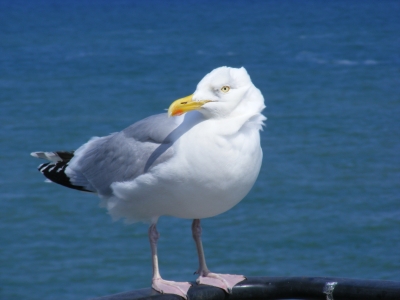
Like Western Gulls, Herring Gulls have pink legs. The two gulls are also the same size.
(In which are recorded the adventures and misadventures of Christopher, his wife Fran, brother Phil and sister-in-law Susan as they pursue a birding Big Year, working together because it’s the only chance they have of making a decent showing.)
We drove down from San Francisco to Monterey, California, on February 1, once again suffering the frustration of birding at high speed with no way to pull over and gaze. I suppose we could have taken the back roads, but we wanted to see the town that inspired John Steinbeck to write Cannery Row.
It’s just as picturesque (and touristy) as it’s reputed to be. The cannery area is, of course, all shops and hotels. On the way into town, we stopped at a small park where we picked up a Black Phoebe launching itself from a twig to catch flying insects and returning to the same twig time after time.
Once again, we didn’t have a lot of time ourselves, but the birding was pretty good. Five or six Surf Scoters floated on the bay, just a hundred feet or so from a pier we shared with anglers and fellow tourists. The Scoters’ bills made them hard to mistake for anything else.
Beyond the Scoters, a small flock of Buffleheads swam away from us. Nearer the Scoters, an Eared Grebe popped to the surface and dove again. On the other side of the pier, we spotted a Horned Grebe and a Red-breasted Merganser. Overhead, the ubiquitous Western Gulls dipped and soared, joined by a few Ring-billed and Herring Gulls.
We decided to have lunch at the El Torito Restaurant that sits right on the water. We sat at a window and watched the Cormorants come and go and crowd an old, broken-down wood and concrete pier.
One of the birds seemed to have a little white on it. Then it flew and clearly had a lot of white on it. We’d seen our first Pelagic Cormorant ever (except for the hundreds we’ve probably seen but didn’t realize it). It added a little more flavor to what was already good Mexican food.
(In which are recorded the adventures and misadventures of Christopher, his wife Fran, brother Phil and sister-in-law Susan as they pursue a birding Big Year, working together because it’s the only chance they have of making a decent showing.)
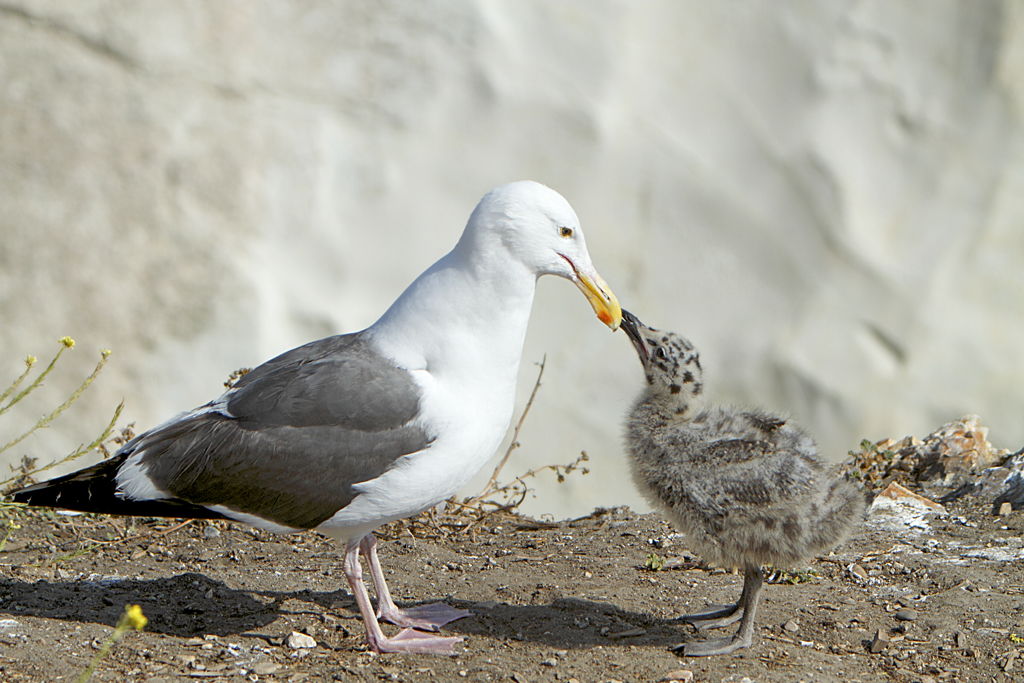
Western Gull and chick. Photo courtesy of Alan Vernon, Creative Commons
We landed in San Francisco around 9:30 on January 29. The airline had called ahead, so there was a wheelchair waiting for Fran and her broken ankle when we arrived. After one of those interminable airport walks, we picked up our luggage and grabbed an AirTrain ride to the rental car counter. We were on our way in just about a half-hour.
Now here’s one of the great frustrations of being a birder and a driver, especially on busy interstate highways: you can’t stop to look. On our way to San Francisco proper we of course drove by a little part of San Francisco Bay. The water was covered with ducks, and a few waders sprinkled the shoreline.
We picked out Scaup because of their black-and-white pattern and Coots because, well, they looked like Coots, but at 65 miles per hour, that was pretty much it. And we couldn’t tell whether the Scaup were Lesser or Greater. We’re not that good. There were a lot of other species represented, too. But we had to give it up and focus on the road.
The Western Gulls were thick everywhere around the city, so we picked up another new species right away. As thick as the Western Gulls were, the fog was thicker, so it was tough spotting much else. It was also raining a little, which we couldn’t begrudge northern California, which has been the grip of an epic drought. So we decided to have a glass of wine.
If you’ve never been to Cliff House, you owe it to yourself to visit if only for the view, and I’m partial to the place on foggy days. The view is spectacular. Rocky spires jut out of the ocean and shatter the waves as they roll in. Gulls spin and twist around the huge picture windows and Double-crested Cormorants arrow by on their way to fish. Also, the wine’s good and not too expensive.
We’ve eaten at one of the Cliff House’s three restaurants, but that was a few years ago, so I can’t vouch for the food. My guess is it’s still good.
We did a little more driving around just to reacquaint ourselves with the area and didn’t see any new species. But it was a classic San Francisco day ending with dinner at Scoma’s on Fisherman’s Wharf with my son Justin who road his bicycle and took the BART over from Berkeley.
Justin had wrinkles. It was a bit of a shock.
(In which are recorded the adventures and misadventures of Christopher, his wife Fran, brother Phil and sister-in-law Susan as they pursue a birding Big Year, working together because it’s the only chance they have of making a decent showing.)
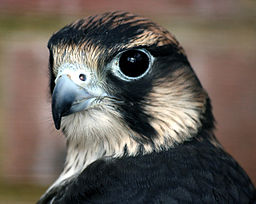
The Peregrine Falcon is known for its mutton chop facial markings – also for taking out other birds at unbelievable flight speeds. Photo by Keven Law from Los Angeles, USA.
January 29, 2014. Fran and I are in the air over what’s probably western Kansas or eastern Colorado on our way to San Francisco, California. We’ll be spending about five days in and around the city, with a trip up to the Napa and Sonoma valleys and a day down the coast around Monterey.
The birds had better cooperate. We’re counting on them to boost our Big Year list, which stands at a paltry 55 species. On the other hand, we have some pretty good birds in the tally.
Last Sunday, January 26, Phil and I returned to Wyandotte County Lake on the Kansas side of the state line. We decided to give the Tundra Swans another chance to show themselves. And they did, finally, after we spent about an hour scoping every one of the 50 or so swans on the water, all but two of which were Trumpeters. Phil now has a persistent squint, but we expect it to go away before our next outing.
It’s not easy to tell Tundra Swans from Trumpeter Swans. Both have black bills and black legs, and they hold their necks pretty much the same way. Their facial markings are slightly different, but not a dead giveaway.
If you’re lucky enough to find a swan with a yellow dot behind the bill, that’s certainly a Tundra. Unfortunately, not all Tundra Swans have the mark and its size can vary a lot.
We were lucky. One of our swans had a tiny yellow speck on its face. We probably wouldn’t have found it, but the two of them were swimming near the Trumpeters, and they were noticeably smaller than their cousins.
But I digress. (Okay, one more digressions: we also saw a Peregrine Falcon harassing the ducks and geese).
We’re hoping to add 30 or 40 species to our Big Year list during our stay in northern California. We also plan to eat a lot of good food and sample that famous wine. There’s nothing like a few hours birding to whet the appetite.
Next time, I’ll tell you about the California birds, the food and the wine. It might take a few posts to get it all covered.
(In which are recorded the adventures and misadventures of Christopher, his wife Fran, brother Phil and sister-in-law Susan as they pursue a birding Big Year, working together because it’s the only chance they have of making a decent showing.)
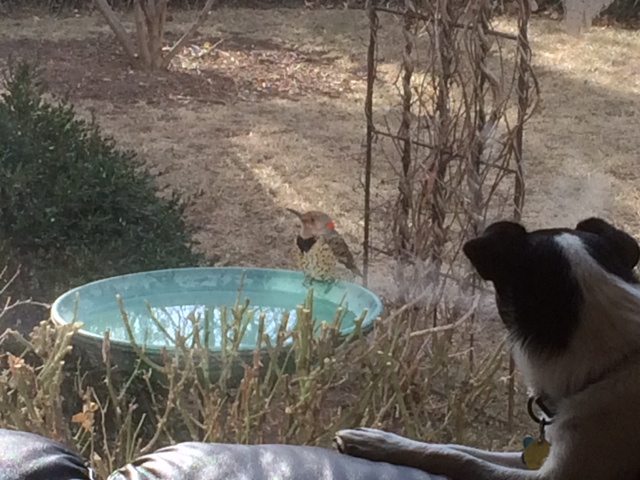
Number 53 on the Big Year list, a Northern Flicker somehow got into this photo of the dog’s ear.
At last, we’ve broken the 50-species barrier. Of course, ordinarily we’d think 50 species was a good single-day birding list. But we won’t quibble. It has been damned cold around here, and we’re not that young – or, speaking for myself, that tough.
Phil and I visited Wyandotte County Lake on the Kansas side of the Missouri/Kansas line last Sunday. There was enough open water to support thousands of ducks, Canada Geese and Snow Geese, as well as some swans. Our primary purpose for visiting the lake was a report of Tundra Swans. We didn’t see any.
But we did pick up Trumpeter Swans, Common Goldeneyes, a lone American Wigeon, Red-headed Woodpeckers, Eastern Bluebirds, Ring-necked Ducks, and an American Kestrel. Also about 10 fat, happy Bald Eagles enjoying the buffet.
I think the eagles get a kick out of just soaring over the ducks and geese to see what kind of response they get. The geese let out a crescendo of honking that begins at one end of the flock and passes like a wave to the other end as the big raptor passes. The ducks raise a ruckus and take flight, though not for long. For them and the geese, it must be like living in perpetual fear of the playground bully.
Speaking of feeling persecuted, Phil celebrated a birthday on January 16. I won’t say which one. As a gift, he got yet another bird feeder for the already vast and growing collection that attracts some pretty interesting species to his and Susan’s backyard, including White-throated Sparrows, Golden-crowned Kinglets, Yellow-bellied Sapsuckers (good grief, who thinks up these names) and others.
I figure keeping him in bird feeders is a good investment. It means we can go on adding to the Big Year list from the comfort of his family room while we watch the University of Kansas basketball team rule the Big 12 (although there are only 10 schools in the conference; go figure).
I don’t want to talk about KU football, so I lovingly invite readers to keep any comments about it to themselves.
(In which are recorded the adventures and misadventures of Christopher, his wife Fran, brother Phil and sister-in-law Susan as they pursue a birding Big Year, working together because it’s the only chance they have of making a decent showing.)
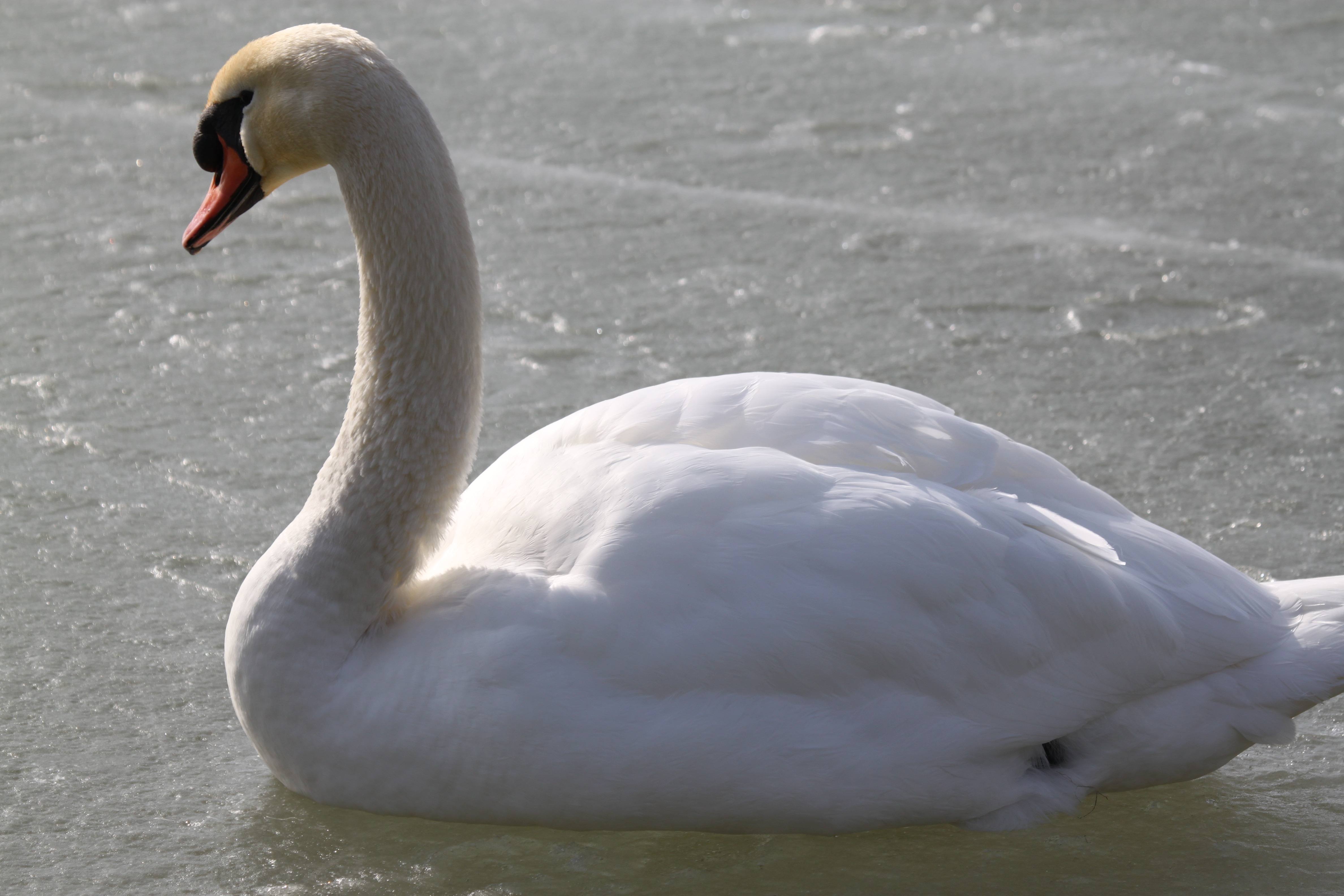
Mute Swans are the easiest of the swans to identify because of their orange bill.
Clearly we are not the dedicated, relentless birders who accumulate lists of 700+ species during their Big Year. So far, after 14 days of the new year, Phil and I, even with the help of our wives, have managed a pathetic 42 species. And this, in spite of Phil’s trip to Florida, which has accounted for 13 new birds.
At this rate, we’ll be lucky to list 150 species all year, especially as finding new ones gets harder. Picking up an American Goldfinch (which we haven’t yet) is a lot easier than seeing an Ovenbird.
Of course, there are compensations and distractions (and they might have a lot to do with why the list is so skimpy). For example, on January 10, Fran and I decided to venture out to Smithville Lake near Smithville, Mo., a haven for rare birds some 20 miles north of our home. We were up and out of the house by 11:00 a.m., stopped for a delicious breakfast at Chubby’s on Broadway in Kansas City, Mo., and made it to the lake about 1:00 p.m.
You can see the problem.
We also had shopping to do, and we wanted to be home in time to watch the Kansas City Chiefs lose to the Indianapolis Colts in the NFL playoffs at 3:30. That meant we had to be on our way to the store and then home by 2:00, giving us just about an hour of birding.
Still, we managed to pick up a Mute Swan, Hooded and Common Merganser, Snow Goose, Great Blue Heron, Bald Eagle and Cooper’s Hawk among several other species. It was a fairly productive hour, even though we didn’t see the White-winged Scoter and a few other rarities that had been reported there. It’s clear that time management is going to be an issue.
There’s also the little problem of early rising. My wife hates it, and I’m not all that crazy about it, either. But we all know that birds like to get up at the crack of pre-dawn, especially as the weather gets warmer and they start thinking about getting on the nest.
For the first time in my life, I think I’m dreading spring.
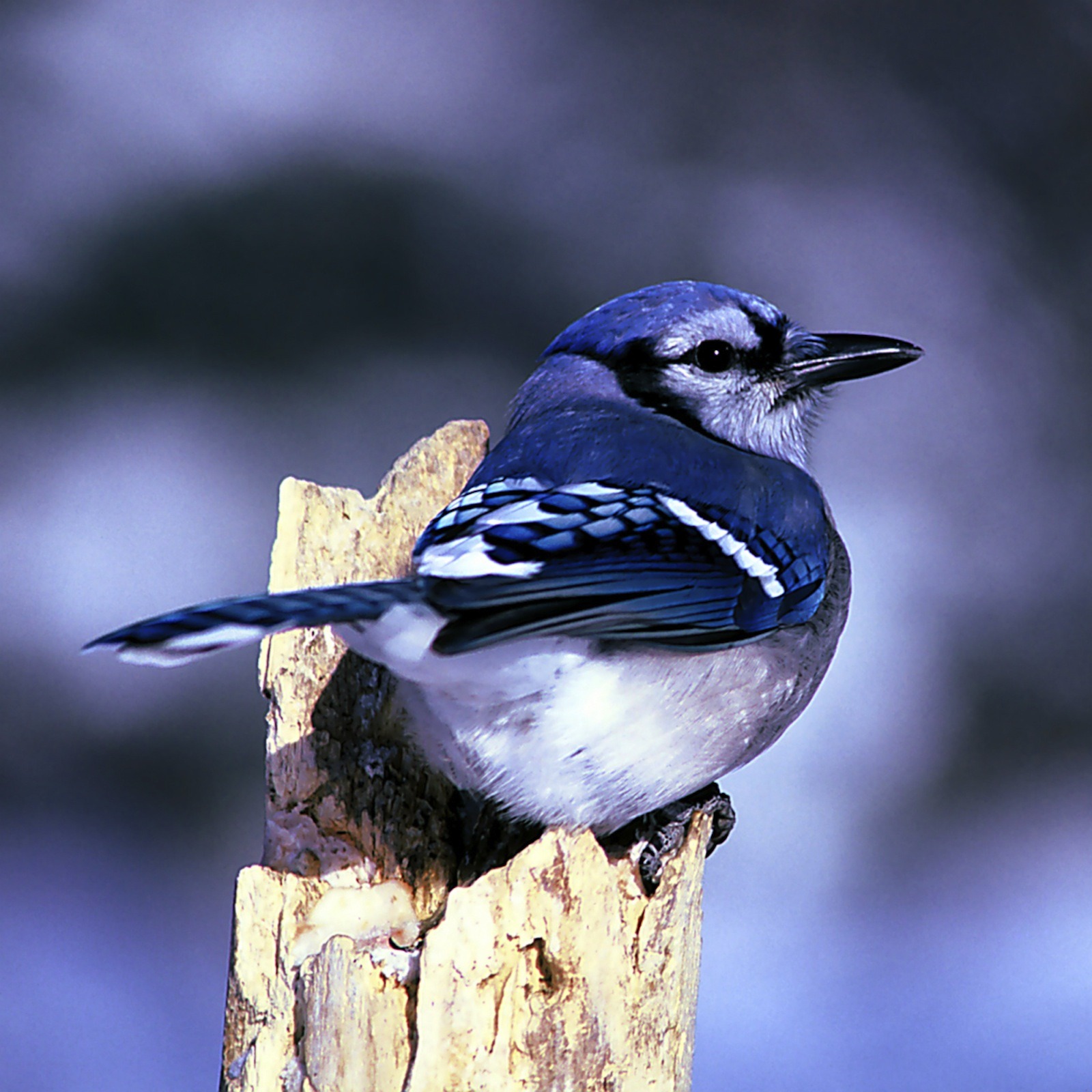
One of the many nice things about birding is that even the most common of species, like the Blue Jay, can dress elegantly.
The game is on.
My brother Phil and I have officially launched our Big Year. It began yesterday, January 1, as the second hand passed 12:00 midnight. We were not birding at the time.
So far, between us, we’ve seen a total of eight species. The count began with a Mourning Dove and continued with House Sparrow, European Starling, Black-capped Chickadee, Blue Jay, Northern Cardinal, Red-tailed Hawk and Dark-eyed Junco.
Okay, so it’s not much of a list, mostly just the backyard species you’d expect from somebody who glances casually out the window. And that’s pretty much what we did. It was New Year’s Day, after all. We had other concerns.
Phil and his wife Susan were recovering from a nasty bout with the flu and stayed in. My wife Fran and I slept a bit late, had lunch out and took in a movie – our traditional New Year’s Day program.
I figure you can’t do it all in one day. You have to sort of ease into these big projects. So on Saturday, Fran and I will take a drive out to Smithville Lake, which is maybe 25 or 30 miles from our home.
The people who report rare-bird sightings on the Internet have been seeing Snowy Owls, Tundra Swans and lots of other goodies on the water and shore. We’ll see if the unusual ones have stuck around for us. My brother and Susan will be in Florida where I’m sure they’ll pick up some nice additions for the list.
I’m hoping to hit at least 50 to 75 species by the end of January. That will take care of most of the common birds around here, with a few rarer ones thrown in. After that, things will get tougher. But spring is coming and so are some more trips – for Fran and me to California in late January and then to Nebraska in late March for the annual Sandhill Crane migration.
Maybe by the end of March we’ll surprise ourselves with a list of a couple hundred species between us. We’ll be keeping the scope handy and the binoculars around our necks.
 Bird Poop