
American Crows make themselves comfortable just about anywhere. Image courtesy of Junior Libby/all-free-download.com.
The crows have come home to roost in my neighborhood. They do this every autumn and winter, and they don’t do it subtly.
Around 4:00 in the afternoon, hundreds of them flap and caw their way into the treetops, arriving like squadrons of bombers over Dresden. And I use that term “bombers” with good reason, as you might imagine.
The thing is, I like American Crows and their jay cousins, including Blue Jays and the much larger Common Raven found out west. Crows have personality.
Like people, they make and use tools. Apparently, they even recognize human faces. If you ever offend a crow, make sure you wear a mask. Studies show crows will remember your face and tell all the other crows about you so they can make your life miserable by screeching at you whenever you show yourself. Reminds me of high school.
Also like humans, crows will eat damned near anything and live and/or breed just about anywhere in North America, except the deep woods and the icy regions. Their only serious enemy seems to be the West Nile Virus, which usually kills them within a week. But even the deadly virus seems to be having little effect on their numbers. It seems that, again like humans, crows like sex, so when one drops dead, another cracks the egg.
Flocks of crows are called “murders” for reasons that remain somewhat controversial. Personally, I think it’s because they yell bloody murder when they come in to roost in those giant flocks. But no one seems to support my opinion.
Crow flocks are also known as cauldrons, musters and a few other group nouns. My favorite, though, is “a congress of crows.” It brings to mind one of my favorite lines from Shakespeare’s Macbeth that I like to apply to a certain august national legislative body: “[I]t is a tale told by an idiot, full of sound and fury, signifying nothing.”
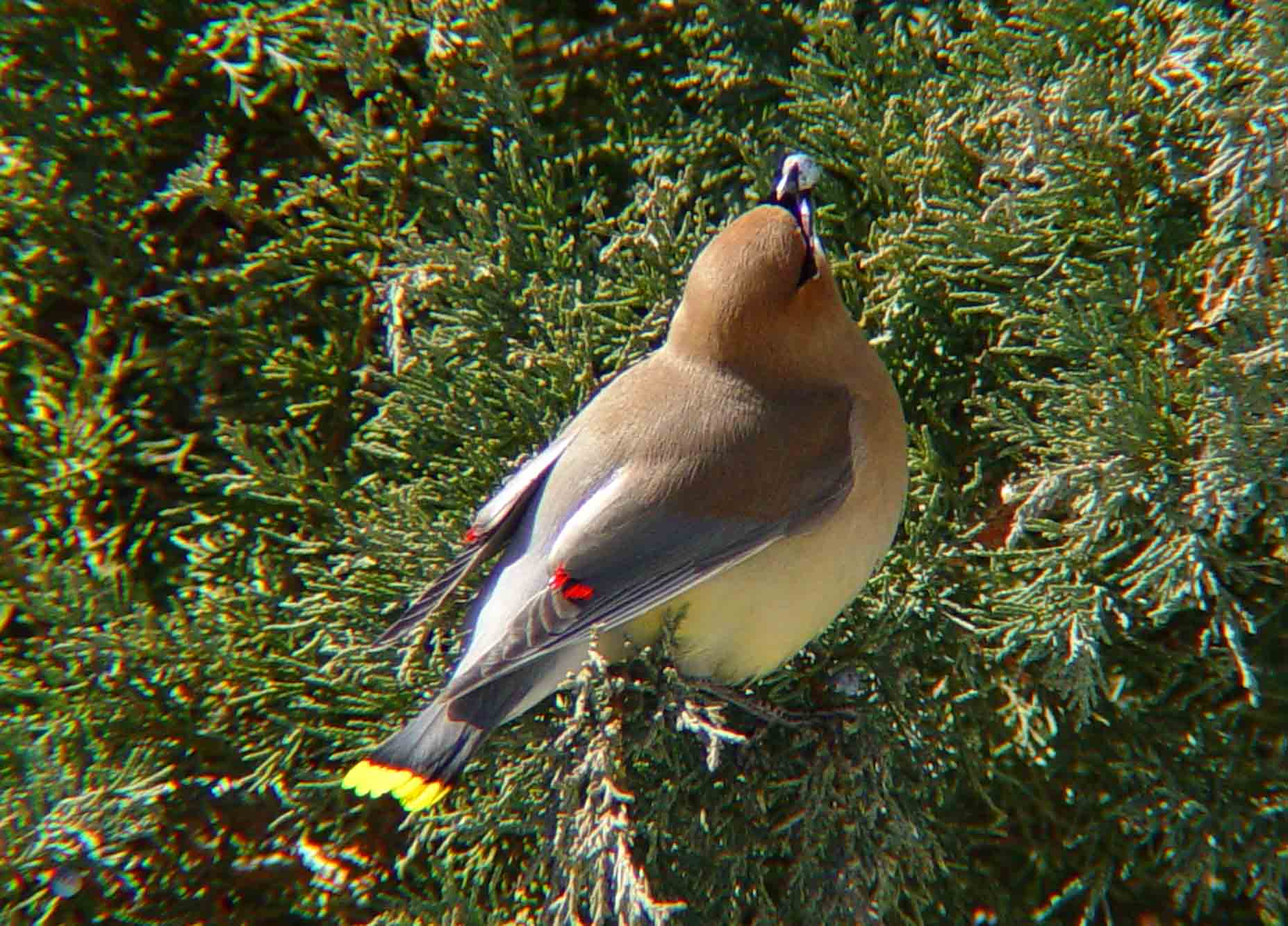
One of the rewards of winter birding in the Kansas City area is catching sight of a Cedar Waxwing. Photo courtesy of Colin Andrews.
For at least the next year, I’ll be writing this blog in the first, rather than third, person. There are a few good reasons for this change. At least, I think they’re good. Most important, it’ll be easier.
With any luck, all the posts I write for the upcoming 13 to 14 months will be about a BIG YEAR. It’s an adventure my brother Phil and I are undertaking with the occasional and possibly reluctant participation of my wife Fran and Phil’s wife Susan.
Okay, so it’s not that BIG a year, but the spirit of the thing is there. We’ve decided to identify as many birds as we can between midnight, January 1, 2014, and midnight, December 31, 2014. This could be a huge challenge.
It could, that is, if we were doing a continental United States big year, dashing all over the country at a moment’s notice to pick up a Bananaquit in southern Florida or a White-faced Storm-Petrel off the coast of Massachusetts. But I for one can’t afford it.
So we’re doing our big year closer to home. Much closer. In and around Kansas City. Within a 15-county area: Cass, Clay, Clinton, Jackson, Lafayette, Platte, Ray, Bates and Caldwell in Missouri and Johnson, Leavenworth, Miami, Franklin and Linn in Kansas. We probably won’t pick up 700 species, but that’s all right. It’ll get us out of the house and we won’t have to stay at a Comfort Inn.
The next few posts will cover our preparations for the odyssey we’re about to undertake. I’ll do my best to make them interesting and minimize discussion about handy breakfast spots and well-located bars.
Let the fun begin.
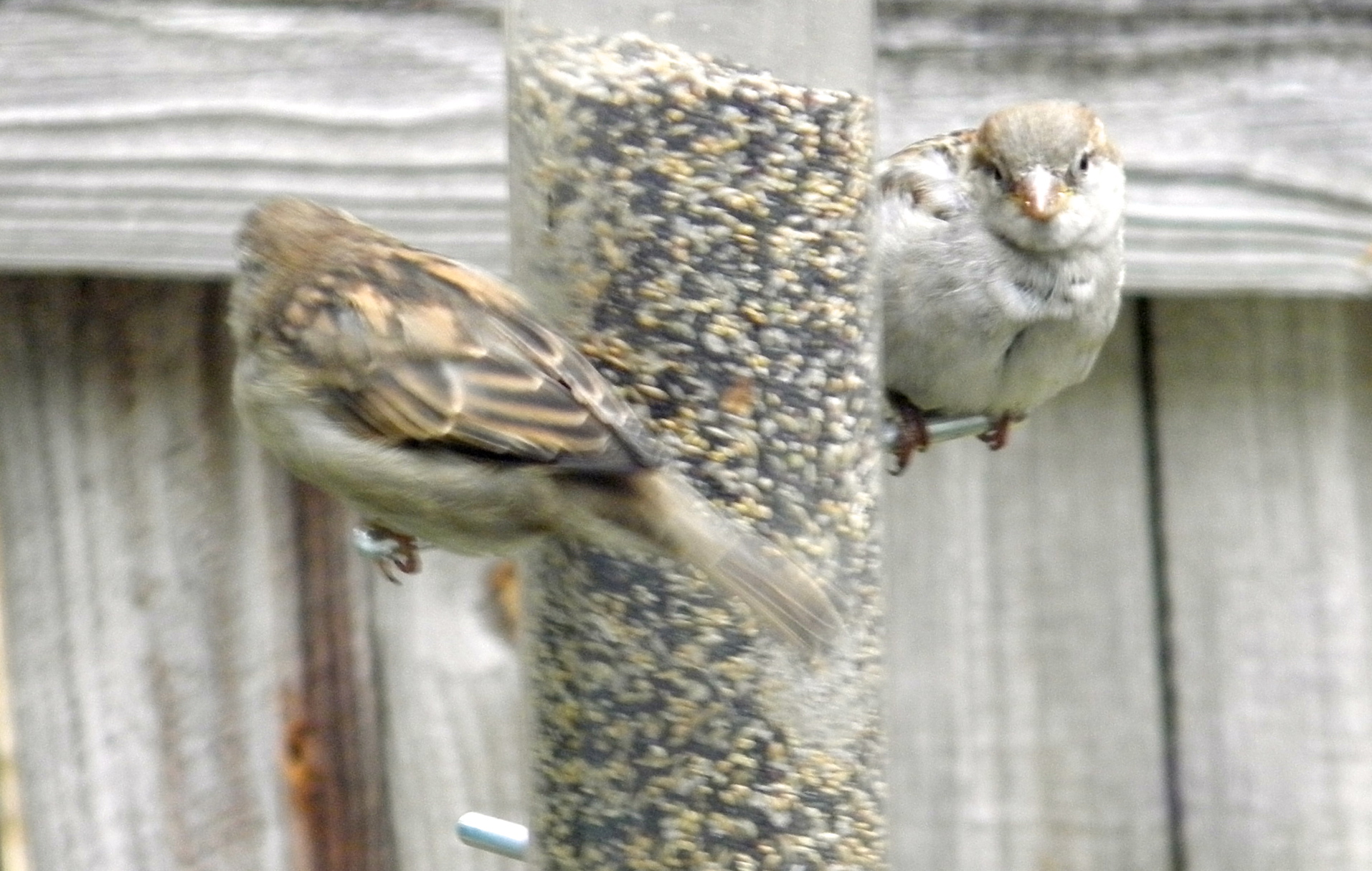
Two female House Sparrows are happy to share the feeder, as long as they can’t quite see each other.
This time of year – late summer, early fall – House Sparrows are like gangs of bratty school kids. Males and females hang out in noisy, pushy, messy little crowds, jostling each other and anything smaller than they are for what they seem to think is the prime perch on the bird feeder. It doesn’t matter that one perch offers no more food than another. It’s apparently just the principle of the thing.
Like the human miscreants they resemble, House Sparrows probably suffer from low self-esteem. After all, they aren’t actually sparrows; they’re finches. But they can’t be called House Finches because that name has already been snatched by a much more attractive bird.
Originally a left-coast sort of fowl, House Finches moved from west to east to conquer much of the continent by the latter decades of the twentieth century. They often sport a crimson, reddish-orange or even yellow head and breast, giving them a certain flare that even the male House Sparrow, with its black ascot-like breast marking, just can’t match. As for the female: it’s dull grayish-brown up top and dull grayish-white down under. The female House Finch at least has stripes to liven up it’s buff-colored breast and belly.
Then there’s the music. House Finches offer a bright, melodious song. House Sparrows peep and screech. Think Michael Bublé vs. Bob Dylan, without Dylan’s poetic sensibilities.
To make matters worse, House Sparrows, unlike House Finches, aren’t even natives. They arrived in Brooklyn, New York, from England in 1851. (Talk about starting out on the mean streets.) Once on shore, they spread until they began showing up just about everywhere people live in North and South America. Other birds, whose nests House Sparrows sometimes displace, could be forgiven for being less than pleased at the usurpers’ arrival.
(Disclaimer: Any reference to the current immigration debate in the U.S. Congress concerning human beings is entirely in the mind of the reader and should be discarded as quickly as every attempt so far to resolve the human immigration debate in the U.S. Congress.)
Whatever their origin and behavior, it seems clear House Sparrows are here to stay and prosper. They’re a lot like people that way.
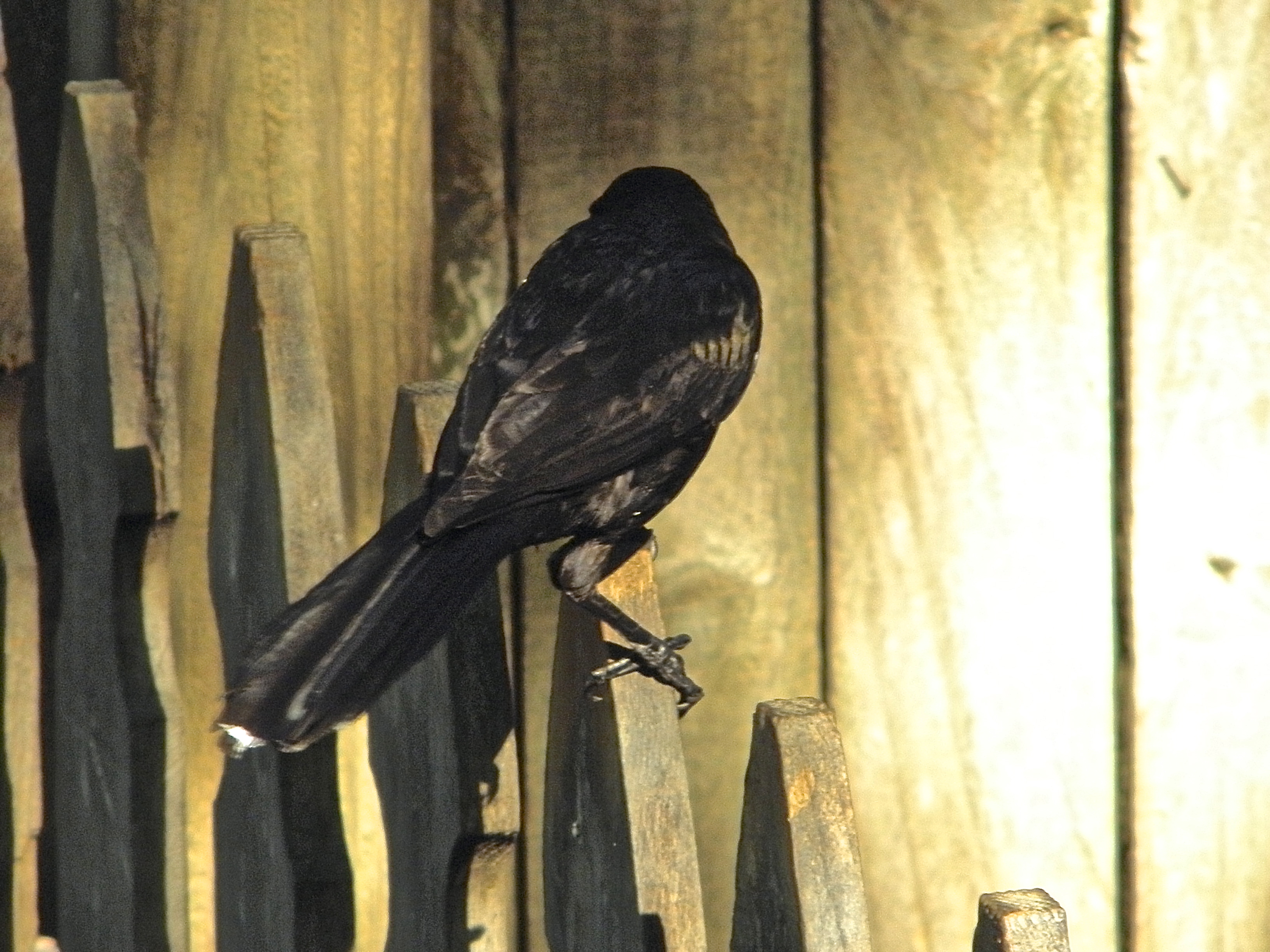
The tail’s the thing for Common Grackles.
Ah, the Common Grackle – its song like an unoiled hinge, its eyes the color of egg yolk, its strut like Donald Trump’s, its temperament the envy of schoolyard bullies.
Move over, American Robins. Make way for the real harbingers of spring. Here in the center of the country, the grackles apparently leave the city in winter to join their blackbird cousins in giant flocks, foraging for what they can find in the farm fields. But they come back to town in March, noisy, hungry, pushy and randy.
A lot of robins, despite the delusions of some romantics, have also been around all winter – in plain sight. This fact does not prevent perfect strangers from stopping each other at the edge of a snowmelt-soaked lawn and pointing wide-eyed at some red-breasted fraud pecking around for careless worms. “Oh, look,” they’ll whisper in wonder and delight, “the first robin of spring!”
What, have these people spent the cold months in bed with the blinds drawn? Robins, much more than grackles, hang out on city and suburban lawns all year long. Robins have the mystique. Grackles have. . .scary yellow eyes.
No one will ever accost an unknown person and, voice crackling with excitement, cry, “Oh, look, the first grackle of spring.” It would be like raising a pant leg and joyously announcing the season’s first wood tick. Anyway, the excited one would be wrong. Chances are the poor bird has been freezing its ample tail off for the past four months looking for leftover corn among the clods out on the farm.
Still, grackles do have their charms – that male tail, for example. It’s a grand boat of a thing, even on the Common Grackle. The great-tailed grackle, which also graces much of the the mid-continent with its presence all year, is a veritable peacock of the blackbird world. Then there’s the way the feathers shimmer from black to purple to violet-green depending on how the light hits them. But, although grackles are considered song birds, their song is, well, not really what most people would call melodious – more like odious.
There’s enough room on the springtime lawn for more than one harbinger. And who wants to be called a harbinger anyway? It sounds like something normal creatures would try to avoid. But that’s neither here nor there.
So here’s to the grackles. No doubt, when we’re all gone and no one is around to use the word “harbinger,” grackles, like rock doves, house sparrows and cockroaches, will still strut their stuff, bringing in the spring just as if there were someone around to notice.
Welcome to WordPress.com! This is your very first post. Click the Edit link to modify or delete it, or start a new post. If you like, use this post to tell readers why you started this blog and what you plan to do with it.
Happy blogging!
 Bird Poop